XRP Price Slides 27% in 2026 as XRPL Stablecoins, Tokenization Surge
XRP fell sharply in the first eight months of 2026, but activity across the XRP Ledger moved in the opposite direction. Stablecoins, tokenized assets, and Ripple’s institutional infrastructure all expanded, creating a widening gap between the XRP price and underlying network development.

Key Takeaways
- From the start of the year, XRP fell 27% by Sept. 1, 2026, even as XRPL daily transactions rose 21% to 2.4 million.
- Ripple’s RLUSD shift pushed XRPL stablecoins higher, deepening its role in payments and tokenized assets.
- Next, investors will keenly watch XRPL’s growth and demand for XRP.
Ripple Pushes Deeper Into Tokenization
XRP has had a difficult year on the price chart. Underneath the surface, however, the XRP Ledger is processing more transactions and attracting more institutional financial activity.
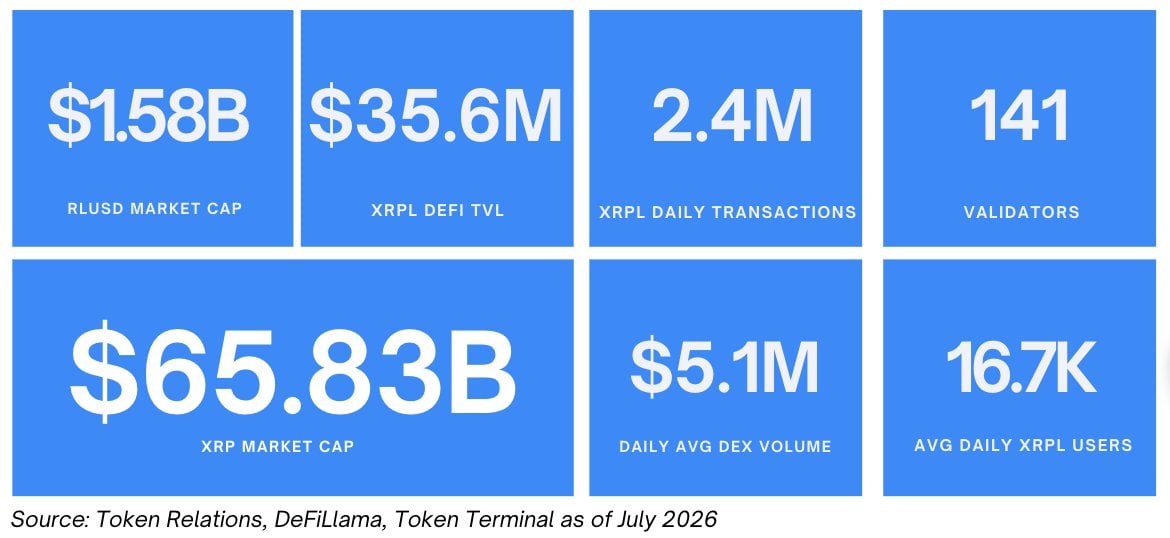
XRP ended July at $1.06, down 42.7% from the end of 2025. Year-to-date, XRP is down 27.5% over the last eight months. Daily trading volume also fell 64% to $2.38 billion as the broader crypto market retreated from the ETF-driven optimism seen late last year. Yet XRPL’s average daily transactions climbed 21% to 2.4 million during the January-to-July period, according to Token Relation’s H1 report on Ripple and XRP.
The contrast matters. XRP price weakness has not stopped Ripple and the wider ecosystem from building infrastructure aimed at stablecoins, payments and tokenized real-world assets, with the network’s validator count rising from 119 to 141.
RLUSD Is Rapidly Migrating to XRP Ledger
The biggest change came from Ripple’s dollar-backed stablecoin. RLUSD’s total market capitalization rose 23.4% to $1.58 billion by the end of July. More significantly, its distribution shifted decisively toward XRPL.
About $907.2 million of RLUSD was issued on XRP Ledger by July, equal to 58.9% of total supply. XRPL’s share stood at just 18.4% at the start of the year. Meanwhile, RLUSD supply on Ethereum declined 39.4% to $632.2 million.
That migration helped XRPL’s overall stablecoin market reach a record $1.02 billion on July 13 before ending the month at $798.4 million, still up 173.9% from December. RLUSD also gained integrations with LMAX Group and Convera, alongside listings on Binance, OKX and major South Korean crypto exchanges.
Ripple Builds Institutional Rails Despite Crypto Slump
Ripple spent the downturn in the first half of 2026 expanding well beyond XRP trading.
The company secured additional European regulatory approvals, opened a regional headquarters in Dubai, and pursued an Australian Financial Services license through its proposed acquisition of BC Payments Australia.
Ripple Prime added institutional access to Hyperliquid, Coinbase Derivatives, and EDX Markets. It also secured a $200 million financing facility from Neuberger Specialty Finance to expand lending capacity.
Tokenization has also become a larger focus. XRPL now supports hundreds of real-world asset tokens spanning U.S. Treasuries, corporate credit, private equity, and real estate, with Ondo and Guggenheim among the institutions represented in the ecosystem.
For XRP holders, the growth in the first half of 2026 looks to be translating into a recovery in XRP’s price, with the token trading above $1.3, up about 32% from its mid-August low of $1.
As the network underneath it becomes more deeply embedded in regulated payments, stablecoins, and institutional crypto infrastructure, the question for investors is whether that growth translates into sustained demand for XRP itself.


Tags in this story
About the Author