The New RWA Meme Coin Meta Has TradFi CEOs Furious
Robinhood Chain traders have found a new use for tokenized U.S. stocks: making investors acquire them before they can buy newly created meme coins, a pairing that is driving significant trading volume and producing bizarre stock prices while Wall Street is closed.


Key Takeaways
- Robinhood’s stock-meme coin craze kicked into high gear, clocking $217 million in Sept. 2 volume.
- BONER vacuumed up 53% of tokenized HIMS, helping send weekend prices soaring past $100.
- AMC CEO Adam Aron came out swinging as Robinhood’s RWA meme coin meta picked up steam.
Robinhood Chain launched July 1 as an Arbitrum Orbit Layer-2 blockchain built around tokenized U.S. equities. Its Stock Tokens are issued by Robinhood Assets (Jersey) Limited and backed 1-to-1 by real shares held in custody. They provide economic exposure and dividends but no voting rights or beneficial ownership, and they are not offered to U.S. persons.
A New Meme Coin Starts With a Stock
For roughly two weeks after launch, Robinhood Chain largely looked like another venue for meme coin speculation. Then, to everyone’s surprise, launchpads long.xyz and Bankr introduced a feature that created what traders are calling the RWA meta.
RWA stands for real-world asset, crypto shorthand for representing traditional assets such as stocks, commodities, and bonds on a blockchain. But this specific trade goes a step further. Instead of merely trading the tokenized stock, users turn it into the currency needed to trade a completely separate meme coin.
Here is how it works.
A creator launches a new meme coin and chooses one of the roughly 90 to 190 available Stock Tokens, such as NVDA, HIMS, AMC or MSTR. Normally, a new crypto token might trade against ether or a dollar-linked stablecoin. Under the Robinhood RWA setup, its main Uniswap v4 liquidity pool instead becomes meme coin/Stock Token.
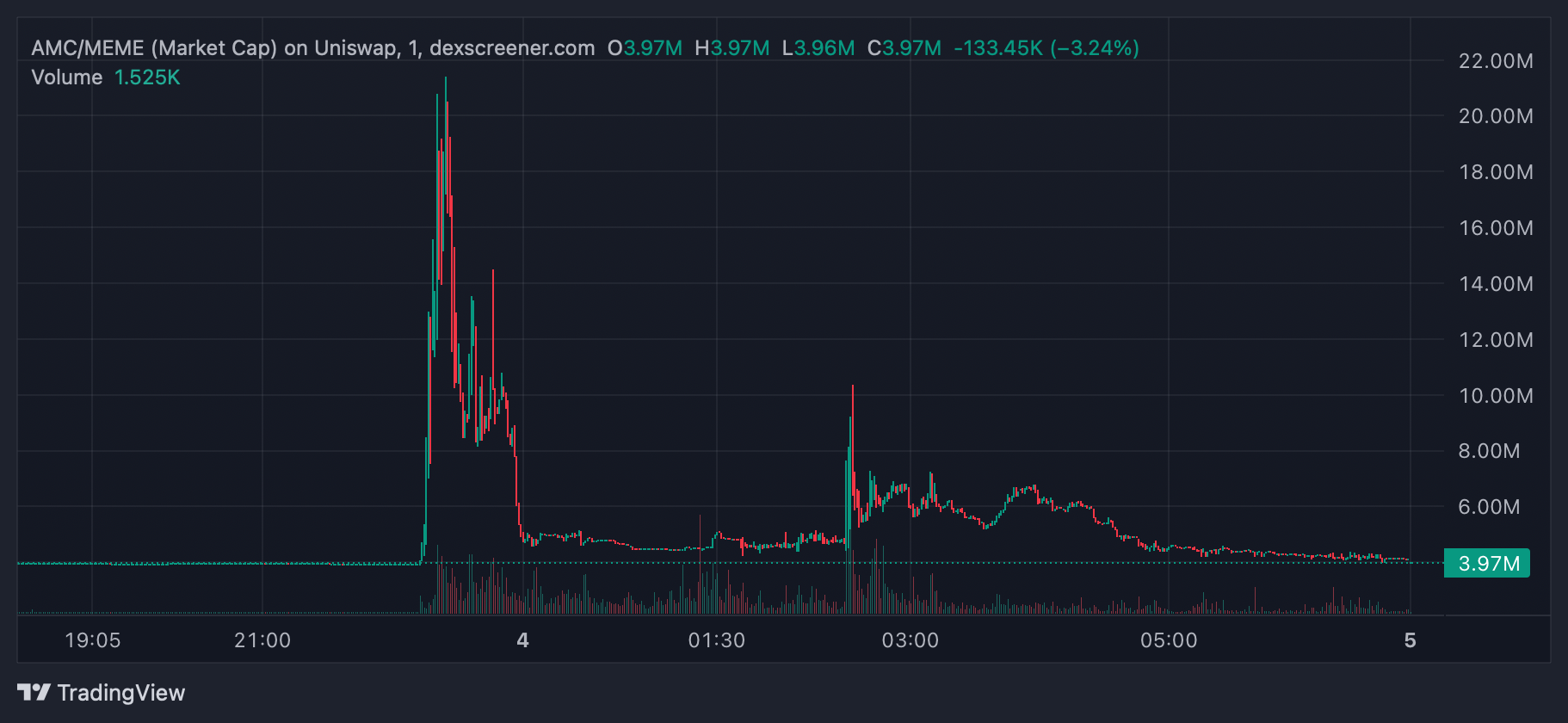
Imagine a new token called MEME paired with tokenized AMC. A trader who wants MEME first needs AMC Stock Tokens. The trader acquires tokenized AMC and sends it into the MEME/AMC pool in exchange for MEME.
That AMC does not vanish after the trade. It remains inside the liquidity pool. As more traders buy MEME, a growing pile of tokenized AMC stock can become locked in the pool while MEME flows in the opposite direction.
Meme buying starts draining the stock-token float
That structure creates two effects at once.
First, every MEME purchase creates demand and volume for tokenized AMC because traders need AMC to enter the meme trade. The meme coin effectively becomes a volume engine for Robinhood’s real-world asset market.
Second, aggressive meme buying can vacuum a great deal of the Stock Token’s available supply into one liquidity pool. That matters because the on-chain supply of these wrappers can be tiny compared with the hundreds of millions of actual shares trading in U.S. markets.
By Sept. 2, the strategy was picking up steam. Meme coin-stock pairs logged $217 million of trading volume, compared with $127 million in direct Stock Token markets. Earlier waves included Artificial Inu paired with NVDA, Saylormoon with MSTR, and Clippy XP with MSFT.
BONER Locks up 53% of Tokenized HIMS
BONER showed what happens when the feedback loop kicks into high gear.
The meme coin launched around Aug. 20 on long.xyz paired with tokenized Hims & Hers. Over about 10 days, traders pushed 31,198 of the 58,714 tokenized HIMS then outstanding into the BONER/HIMS pool.
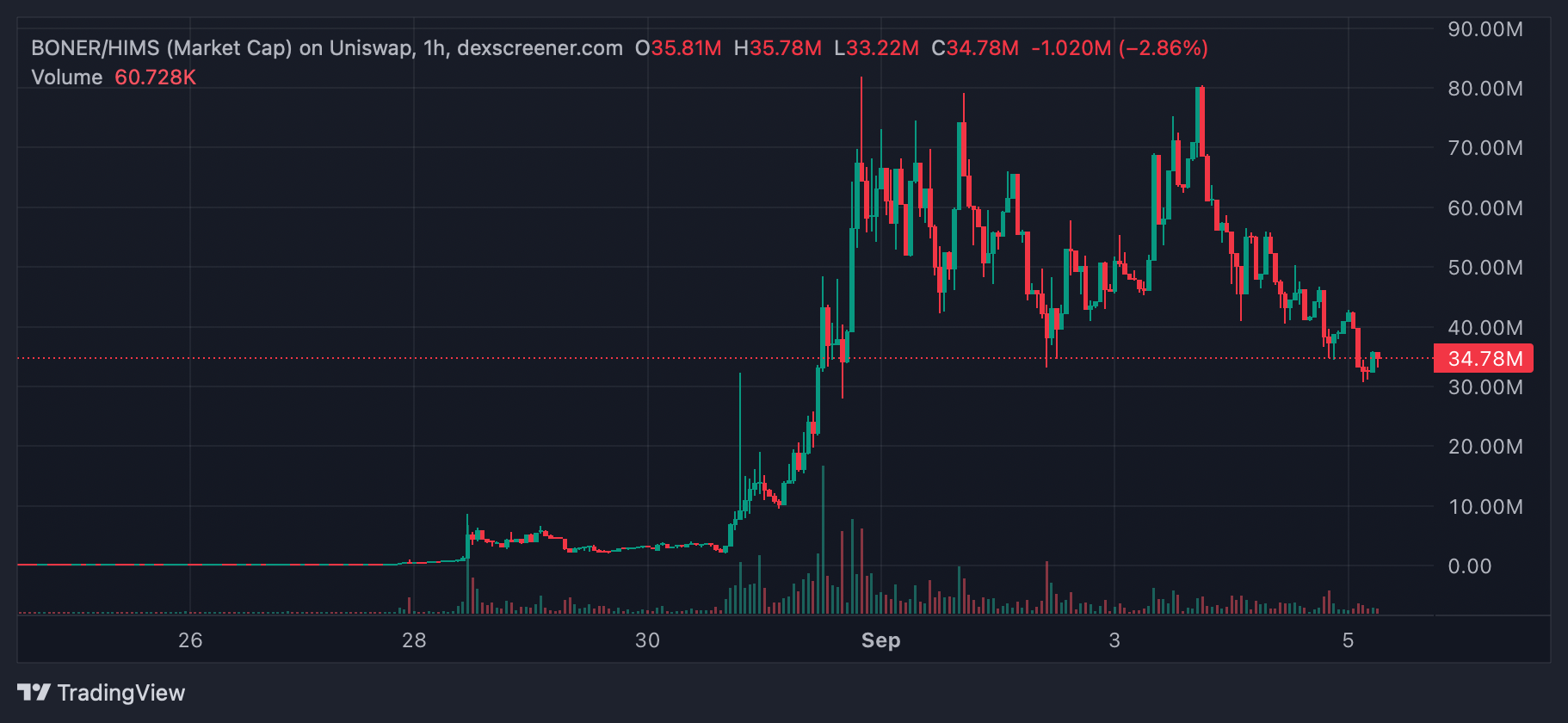
That was 53% of the entire on-chain float. Another 1,424 HIMS sat in other meme coin pools, leaving roughly 20,300 tokens available for ordinary trading.
The real Hims & Hers stock, on the other hand, had roughly 233 million shares. The blockchain market was a rounding error beside the actual company. That difference is crucial to understanding what happened next.
Wall Street Closes and the Wrapper Starts Breaking Loose
Robinhood allows only licensed authorized participants to mint or burn Stock Tokens. Those participants can mint new tokens only while the New York Stock Exchange is open.
Crypto does not have the same schedule.
When Wall Street closes on Fridays, meme coins can keep trading through Saturday and Sunday, but the Stock Token supply becomes fixed. If enough HIMS have already been parked inside BONER/HIMS, traders looking for additional HIMS are left fighting over a shallow remaining supply.
The NYSE closed Friday, Aug. 28, with real Hims & Hers shares at $28.84. After a small post-close burn, on-chain supply stood at 15,226.8 HIMS tokens. No fresh minting was available on Saturday or Sunday.
By Sunday evening, most of the remaining free float was sitting inside the BONER pool. The ordinary HIMS/USDG market was only tens of tokens deep.
A Few Trades Send Tokenized Hims Above $100
Automated market makers, or AMMs, make this setup especially volatile. Instead of matching individual buyers and sellers like a traditional stock exchange, an AMM calculates prices according to how much of each asset remains inside a liquidity pool.
When one side becomes extremely scarce, relatively modest purchases can cause enormous price changes.
Tokenized HIMS printed $61.15 at 23:36 UTC Sunday, a 112% premium to the real stock’s Friday close. Other reports cited an hourly high of $132.64 on only a few tens of thousands of dollars in volume.
Funnily enough, Hims & Hers itself had done nothing to justify the move. Its larger tokenized market on Ondo continued tracking the real equity. What got squeezed was Robinhood’s thin weekend wrapper, not the underlying company.
Monday Opens the Floodgates
Robinhood’s overnight equity session opened at 00:00 UTC on Monday, putting authorized participants back in the driver’s seat.
The first 1,000-token mint arrived at 00:43:30 UTC. Within 12 minutes, the premium collapsed from roughly 93% to about 12%. By 01:59 UTC, tokenized HIMS was clocking $29.31.
Between midnight and 09:54 UTC, 18,750 new tokens were minted across 294 events, more than doubling supply. Market-making wallets sold the new inventory into the premium.
The economic incentive is straightforward. An authorized participant can buy real HIMS near $29, mint the corresponding Stock Tokens 1-to-1 and sell those tokens into an on-chain market quoting a much higher price. New supply keeps arriving until that gap becomes too small to make the trade worthwhile.
This Is Not a Gamestop-Style Short Squeeze
The Monday reset exposes the biggest misconception surrounding the RWA meta.
Locking tokenized HIMS inside BONER does not force short sellers of real Hims & Hers shares to cover their positions. Robinhood Stock Tokens are Jersey-issued securities providing economic exposure. They are not actual HIMS shares on the company’s transfer agent and cannot be delivered into a traditional stock-loan book.
Scale also kills the squeeze thesis. The entire tokenized HIMS float represented only a tiny fraction of the real company and about 0.1% of its reported short interest.
What traders squeezed was the wrapper’s weekend float.
The Stock Token can get clobbered or shoot several times above its underlying value because its supply is temporarily constrained. When minting returns, arbitrageurs sell fresh tokens into that premium and the wrapper snaps back toward the real stock.
On the flip side, the meme coin does not necessarily get crushed when that happens. BONER remained up more than 1,000% on the day after HIMS re-pegged because meme buyers were pricing attention and narrative, not the value of Hims & Hers.
AMC Turns the Trade Into a Corporate Fight
The same RWA meta has now reached AMC Entertainment through a token called MEME paired with tokenized AMC.
MEME generated a reported $73.5 million in 24-hour volume, the highest among the stock-meme group, with a market capitalization of around $56 million and roughly $2.6 million in its main liquidity pool.
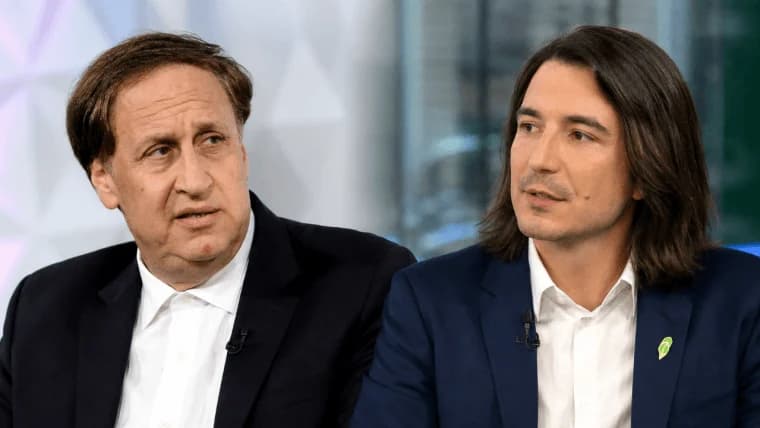
Then AMC CEO Adam Aron came out swinging.
Aron said AMC had no connection to Robinhood’s tokens, did not condone them and questioned how a Jersey-based product could use AMC’s name without U.S. securities registration. He later called the system a “fictitious synthetic equity market,” demanded Robinhood cease trading AMC Stock Tokens, and said outside counsel and the Securities and Exchange Commission (SEC) would become involved.
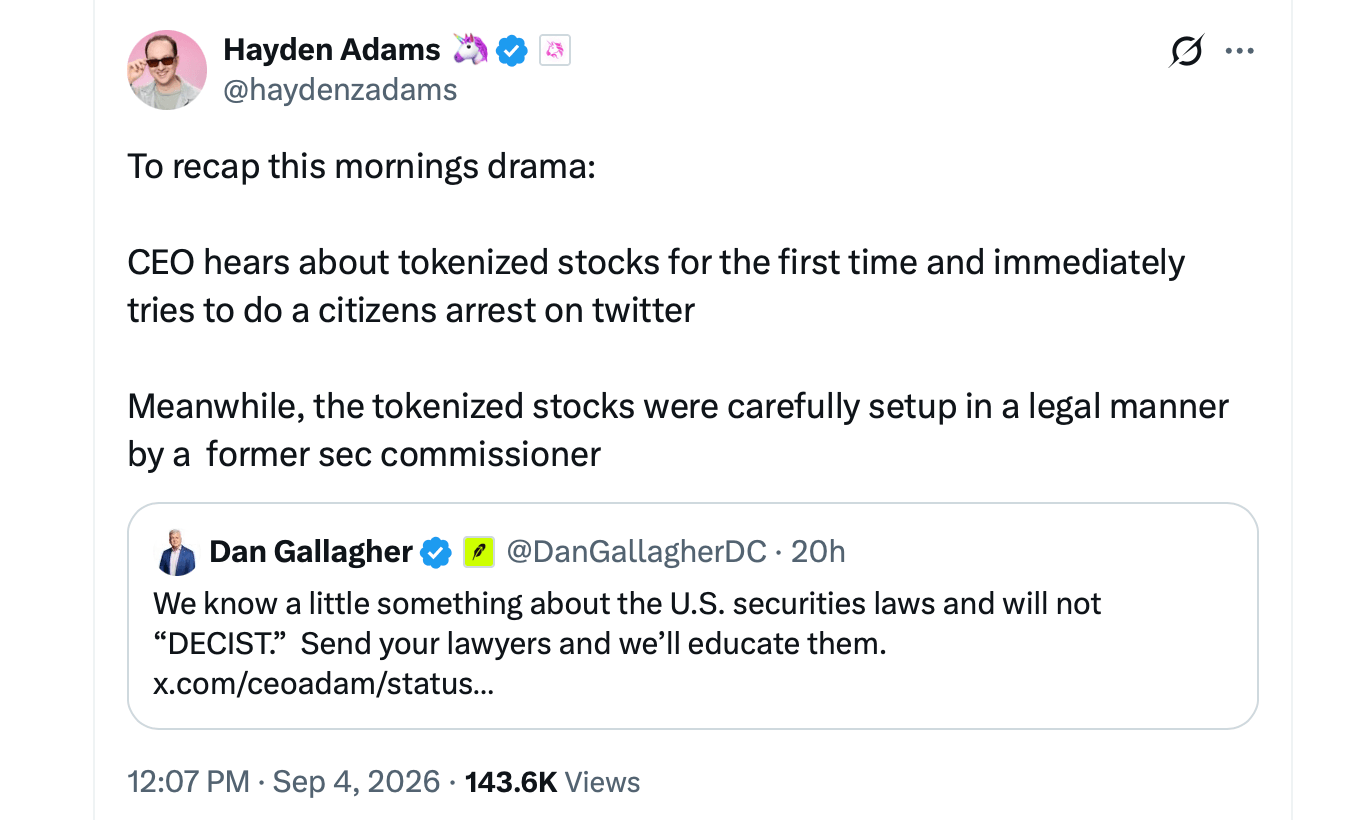
Robinhood CEO Vlad Tenev responded, “What’s the concern?” Chief Legal Officer Dan Gallagher, a former SEC commissioner, also pushed back and said Robinhood would not stop. Robinhood’s position is that Stock Tokens are clearly disclosed Jersey-issued products that provide economic exposure rather than ownership of the underlying shares.
The Controversy Becomes Fuel for Another Meme Cycle
Weirdly enough, the fight itself became part of the trade.
AMC already carries enormous cultural significance in meme-stock markets. Aron’s criticism, Tenev’s response, and Gallagher’s public pushback gave traders a fresh narrative. Derivative meme coin tickers appeared around the dispute, turning the argument over tokenization into marketing for the very market Aron was attacking.
That reveals the second half of the Robinhood RWA meta. The Stock Token supplies the mechanics, but the meme coin supplies the distribution.
Every incoming meme buyer must acquire the tokenized stock. Those purchases manufacture RWA volume as a byproduct. The tokens then accumulate inside meme pools, reducing the free float and making the remaining Stock Token market easier to move.
The Real Edge Belongs to Whoever Can Mint
The result is three trades stacked on top of one another.
Launchpads and creators collect fees as traders chase the meme coin. Meme buyers create demand for the Stock Token and can drain its available float. Then, if the wrapper breaks far above the underlying stock, authorized participants get the structural arbitrage opportunity when minting resumes.
The last group has an advantage ordinary meme traders do not: access to a fresh supply.
That is why a weekend print of a $100 tokenized AMC or $132 tokenized HIMS does not mean the real stock is headed there Monday. The writing’s on the wall once authorized participants can mint again. They can buy the cheaper real asset and sell newly created wrappers into the inflated blockchain market.
Robinhood’s RWA Experiment Faces Its Next Test
The broader significance is that Robinhood built a permissionless blockchain around tokenized traditional assets, and traders almost immediately found a way to use those assets as quote currency for a meme coin casino.
The structure has already moved the needle. Meme coin-stock pairs were logging more volume than direct Stock Token markets by early September, while BONER demonstrated how locking a significant share of a thin wrapper can send weekend prices off the rails.
What happens next is anyone’s guess. The AMC confrontation could bring more legal or regulatory scrutiny, while traders could continue pairing new meme coins with whatever tokenized stock provides the best narrative.
Until the market design changes, however, another wild ride remains in the cards. Meme traders can vacuum Stock Tokens into liquidity pools while Wall Street is closed, creating eye-popping scarcity prints. When traditional markets reopen, authorized minters can open the floodgates, harvest the premium, and pull the wrapper back toward the real share price.
The meme coin may keep running. The supposed stock squeeze is another story.


Tags in this story
About the Author