

Written by Andrew Fentonstaff editorReviewed by Andrew Fentonstaff editor
Written by Andrew Fentonstaff editorReviewed by Andrew Fentonstaff editor‘White hats’ take 4000 BTC from Liquid, ETFs see best week of 2026: Hodler’s Digest
Purported white hat hackers have taken 4000 Bitcoin from the Liquid sidechain in a major security breach. The Bitcoin ETFs see the best three weeks of inflows in 2026.

Liquidated: ‘All your Bitcoin are belong to us’
A shade under 4000 Bitcoin worth $319 million has been taken from Liquid Network — with purported “white hat” hackers claiming responsibility. An unverified OP_RETURN message read: “we are whitehats. contact us on chain.”
The Blockstream-run Bitcoin sidechain has been paused as the team attempts to identify the security hole and negotiate the return of funds. The Liquid explorer shows the balance of its federation wallet dropped from 4,200 BTC down to just 207.275 BTC, with 3,998.5 Bitcoin withdrawn.
Under normal Liquid mechanics, LBTC is burned on the sidechain before Bitcoin is withdrawn. The transaction needs to be authorized by an 11 of 15 multisig, and funds are sent to an approved whitelist.
Liquid Network posted earlier today that: “the funds were withdrawn via the SideSwap PAK (Peg-out Authorization Key), but that key was not compromised, nor were any others.”
“Bridge nodes have been temporarily disabled, so no new transactions can be submitted to the network. Effectively, the Liquid sidechain is paused until this issue is resolved.”
Crypto analyst DBCrypto noted that: “the coins aren’t running and they’re just sitting on Bitcoin and haven’t been mixed. That’s more consistent with a whitehat extraction than a theft.” But he said the incident raised some big questions about security on the sidechain. “Either 11 of 15 functionaries signed this off, or the whitelist built to prevent exactly this didn’t hold. Neither answer makes Liquid look good.”
So far Blockstream and Adam Back have not posted about the incident on X. This is a developing story.

Bitcoin ETF inflows hit $3.8B in strongest three-week stretch of 2026
While Bitcoin is yet to hold above the 50-week moving average that would confirm a bull market, there are other signs bull market conditions are returning. The US spot Bitcoin ETFS have just recorded their strongest three-week inflow stretch of 2026 as Bitcoin trades just above $80,000.
The funds attracted $986.9 million in the week ending Friday, bringing net inflows over the past three weeks to $3.8 billion, according to SoSoValue data.
Total net assets across the funds stood at $101.3 billion on Friday, while cumulative net inflows reached $55.6 billion. On Thursday the Bitcoin ETFs recorded $730.9 million in net inflows, for the strongest showing since Jan. 14.
AMC boss cracks it over Robinhood’s tokenized stocks
Robinhood has been a stunning success so far, leading chains for daily fees and flipping Solana’s 24 hour DEX volume. It’s token launchpad PONS even broke into the Top 100 coins this week with a stunning 140% gain. Part of the interest has been in the Ethereum L2’s pairing of memecoins with tokenized stocks like AMC.
But while crypto degens love it, AMC’s CEO Adam Aron is less than impressed and has threatened to send in the lawyers over the chain’s “outrageous” decision to tokenize AMC stock without his express permission. He wrote on X:
“I find this practice to be contemptible, outrageous, disgusting, detestable, inexcusable, vile. How can it possibly be legal? We have no connection to this at all, and do not condone it in any way. “
Robinhood co-founder Vlad Tenev trolled him by asking blithely: “What’s the concern?” which sent Aron off on another rant about Robinhood’s “shocking and shameful” conduct. He called on them to “CEASE AND DECIST (sic)” and said the SEC could not possibly support Robinhood’s “sham ignoring of US securities laws. You can be sure we will be asking them.”
Robinhood’s chief legal officer Dan Gallagher — a former SEC commissioner — wrote back:
“We know a little something about the U.S. securities laws and will not “DECIST.” Send your lawyers and we’ll educate them.”
What a savage.
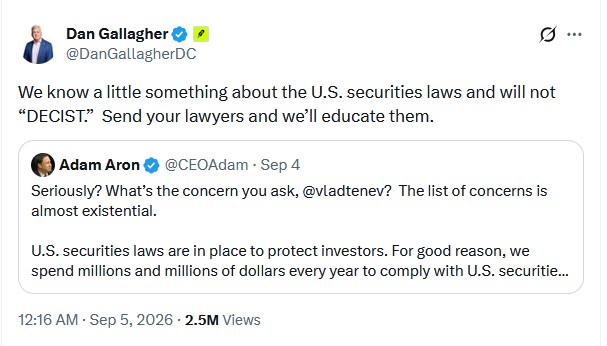
Source: Dan Gallagher
BofA, Citi, Goldman Sachs among 21 institutions planning stablecoin launch
A group of 21 major financial institutions plans to establish a new company to develop and issue stablecoins.
The consortium, announced Tuesday, includes Bank of America, Goldman Sachs, Citi, Deutsche Bank, UBS, Santander, MUFG and Fidelity Investments. It plans to launch a US dollar-denominated stablecoin in the first half of 2027, subject to the company’s formation and other conditions.
According to the announcement, the group ultimately plans to expand into stablecoins denominated in other G7 currencies, with a euro offering identified as its next priority.
In other news that crypto is playing with the big boys now, the G20 member nations put out a joint statement supporting crypto as a transformative way to bring about “broad-based economic growth.” It committed member nations to “advancing responsible and effective regulatory and supervisory frameworks that preserve financial stability, support economic growth, and establish clear pathways for sound digital financial and digital assets innovation.”
Kalshi bans Santos for life as New Jersey attempts to ban Kalshi for life
Prediction market platform Kalshi has banned ousted Republican lawmaker George Santos for life for allegedly using insider information for trading on event contracts. It’s one of the first lifetime bans the company has imposed since its launch in 2021. Kalshi said that Santos had been betting on markets involving his own actions, and stated he had “engaged in trading activity in certain markets related to his attendance at the State of the Union address” in February 2026.
In response to the ban, Santos called Kalshi an “unserious company.”
Meanwhile New Jersey’s Attorney General officially petitioned the US Supreme Court to hear a case aimed at resolving whether state authorities or federal agencies have jurisdiction over prediction market companies. Officials cited civil cases brought by gaming authorities in “at least 20 states” that required the court to decide if state laws or the Commodity Futures Trading Commission’s rules took precedence.
“These companies have no right to offer their sports bets without following state law, which is why dozens of States across the ideological spectrum have opposed them […] We’re calling on the Supreme Court to resolve this issue and recognize that Congress did not silently make the sports-betting industry immune from state law.”

Winners and Losers
At the end of the week, Bitcoin (BTC) is up 2.6% to trade at $80,234, Ethereum (ETH) is up 2.3% to trade at $2,513 and XRP (XRP) is up 3% to $1.42. The total market cap is at $2.72 trillion according to CoinMarketCap.
Among the biggest 100 cryptocurrencies, the top three altcoin winners of the week are Pons (PONS) with a 140% gain, Arbitrum (ARB) on 116%, and Dash (DASH) on 66%.
The top three altcoin losers of the week are Pump.fun (PUMP) which was down 13.2%, Canton (CC) down 6.9% and Official Trump (TRUMP) down 4.1%.
Top Prediction of the Week

BTC will hit $1M by 2030… but Arthur Hayes is buying ETH instead
BitMEX founder Arthur Hayes told Cointelegraph the collapse of the AI bubble, “massive” money printing, and potential US yield curve control are among some of the reasons why Bitcoin could go to $1 million by 2030. “We have the ingredients. The time is now. So I think the $58,000 was probably the bottom in Bitcoin, and now it’s going to grind higher in this hate fuck rally,” the 41-year-old billionaire said.
But he added the best risk reward adjusted bet in crypto right now wasn’t Hyperliquid, but ETH and he’s been amassing a sizeable position. “That doesn’t necessarily mean that Hyperliquid won’t rise in price. I just don’t think it’s poised for a 5x, and like where I think Ethereum could do, you know, 3x to 5x pretty quickly,” he said.
Top FUD of the Week
El Salvador’s post-review Bitcoin accumulation used no public funds: IMF
El Salvador used no public resources to accumulate Bitcoin after the first review of its International Monetary Fund (IMF) financing program in June 2025, according to reports this week.
The IMF reportedly said documents supplied by Salvadoran authorities verified that the accumulation came from private donations. That would mean the increase in El Salvador’s holdings did not reflect additional Bitcoin purchases financed with government resources.
The IMF also said majority ownership and operational control of the Chivo wallet had been transferred to a private operator, while the government retained a minority stake and custodial responsibilities.
But President Nayib Bukele called the story “fake news” and said the claim that El Salvador had transferred its Bitcoin returns to a private party was “TOTALLY FALSE.” He pointed to this IMF link as evidence:
“Read it. It clearly says the opposite: that the only thing that was transferred were Chivo shares, something that was offered a year and a half ago, and NOT the Bitcoin Strategic Reserve.”
Fake Claude desktop app spreads crypto-stealing malware
A fake Claude desktop application is reportedly being used to distribute RevStealer, a Windows malware strain built to steal crypto, password and browser data.
According to a Monday report by cybersecurity company Morphisec, RevStealer was previously distributed through GitHub repositories and game-cheat-themed sites but the most notable is a fake “Claude Opus 5 Free Desktop” project that impersonates AI developer Anthropic and promises free access to Claude.
The researchers noted that the malware is designed to leave few traces and searches browser databases, cookies, password-manager records, VPN and remote-access settings, messaging data, screenshots and selected documents. RevStealer also targets over 50 cryptocurrency wallets.
Hyperscale Data ends Michigan BTC mining as holdings fall 79%
Hyperscale Data has ended all Bitcoin mining operations at its Michigan facility as it prepares the site for an artificial intelligence data center customer.
On Wednesday, the company said that all Bitcoin miners at the facility were switched off and that it intends to sell the associated mining equipment.
Hyperscale said the AI customer has contracted for 20 megawatts (MW) of computing capacity under a 10-year master services agreement with two optional five-year extensions. The agreement may generate more than $1.2 billion over the maximum 20-year term. An additional 32 MW option could lift potential revenue above $3 billion, while the site is expected to support 340 MW.
Hyperscale has also reduced its Bitcoin holdings sharply while funding the AI buildout. It’s holdings have dropped from 1006 Bitcoin at the end of July to around 215 BTC today.
Top Magazine Stories of the Week
Mystery surrounds why an OG burned $1M in Bitcoin
The million dollar question is what prompted a Bitcoin OG to send 20 BTC to a custodian, retrieve it back, and then deliberately burn it?

Does the Bitcoin rally mean we haven’t wasted our lives in crypto?
Crypto is showing signs of life again, but its biggest wins look different from what early believers imagined. After a decade of building, has it all been worth it?
Token buybacks are booming. But are they good for crypto projects?
Crypto projects are spending hundreds of millions buying their own tokens. But are buybacks creating lasting value — or just making tokens look more valuable than they really are?
Recovery specialists crack $1B crypto wallet… but find just $10
Crypto recovery specialists reveal how lost wallets, passwords and seed phrases can sometimes be recovered — but that’s of no help if the money was never there in the first place.


Subscribe to daily byte-sized crypto news from Cointelegraph
More on the subject



About the Author