
CLARITY Act Odds Slide to 18% as Banks and State AGs Push Back
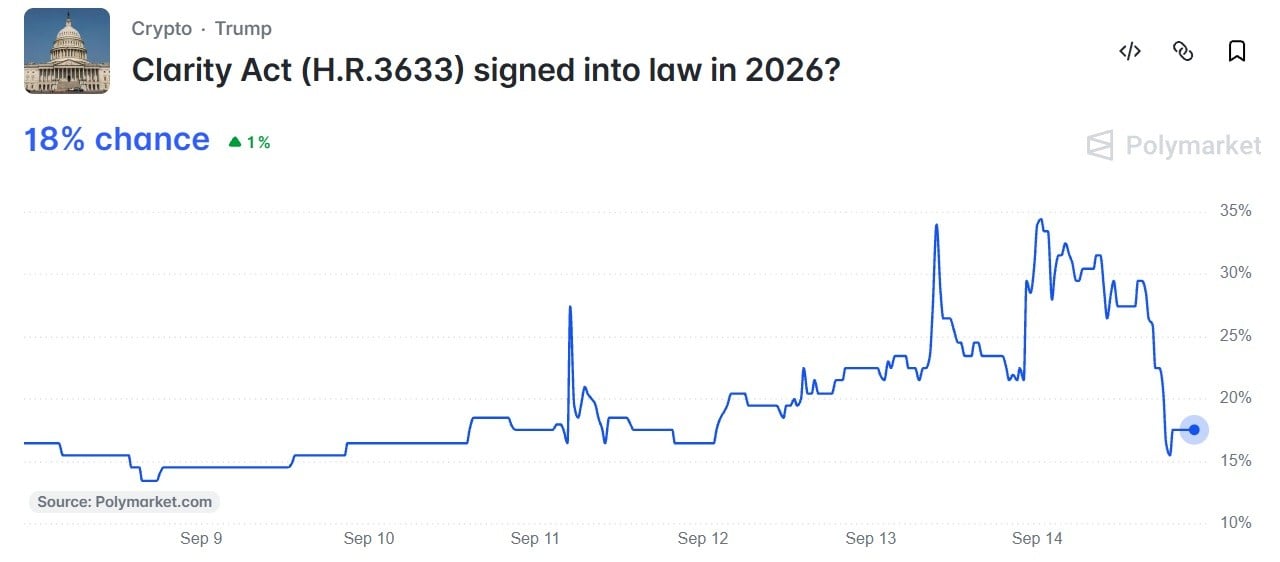
Polymarket traders now give the CLARITY Act an 18% chance of becoming law in 2026, down from roughly 34% earlier on Sept. 14 and 82% in February. Bank and state opposition has left key disputes unresolved before a Senate vote.

Key Takeaways
- CLARITY Act odds fell to 18% on Sept. 14.
- Banking groups demanded tighter restrictions on stablecoin rewards.
- The bill must overcome opposition and multiple legislative hurdles.
Why CLARITY Act Odds Fell Back to 18%
The CLARITY Act’s rebound unraveled within hours as traders reassessed whether the final compromise could attract enough Senate support. Polymarket’s live CLARITY Act contract showed an 18% chance at 8 p.m. EDT on Sept. 14, with $17.19 million in cumulative volume. The contract requires H.R. 3633 to pass both congressional chambers and receive the president’s signature by Dec. 31.
Earlier that afternoon, crypto asset manager Grayscale displayed Polymarket and Kalshi estimates near 29% in a post on X. Grayscale wrote, “CLARITY is coming: probability of the CLARITY Act passing this year surge to ~29%.” Polymarket’s price chart shows the contract peaked near 34% earlier on Sept. 14. The evening reading was 16 percentage points below that high and 11 points below the probability Grayscale highlighted. Prediction-market prices represent implied probabilities that change as participants buy and sell contracts tied to an outcome.
The drop coincided with evidence that the final draft had not settled two politically sensitive disputes: stablecoin rewards and state enforcement authority. Supporters also need 60 votes to advance the measure, seven more than the 53 seats held by Republicans. The official Senate schedule shows the cloture motion on proceeding to the bill ripening at 2:15 p.m. EDT Sept. 15.
Banks Say the Stablecoin Safeguard Comes Too Late
Eight banking trade groups urged Senate Majority Leader John Thune and Democratic Leader Charles Schumer to strengthen the stablecoin provisions in a Sept. 14 letter. The organizations argued that the final language leaves pathways for exchanges and other service providers to offer interest-like rewards that could pull deposits from banks and reduce money available for mortgages, agricultural credit, and small-business lending.
The groups rejected a proposed regulatory circuit breaker that would respond after substantial deposit flight had occurred. They wrote, “However, a circuit breaker that activates only after substantial deposit flight has already occurred is not a safeguard at all.” Their recommended amendments would broaden the prohibition and remove language allowing rewards to be calculated based on a customer’s stablecoin balance, holding period, or tenure.
The banking objections target a provision Republicans described as a strong circuit breaker to protect community banks. U.S. Senators Cynthia Lummis (R-WY), John Boozman (R-AR), and Tim Scott (R-SC) released the final CLARITY Act draft with Treasury authority to address deposit flight tied to payment stablecoins.
State Opposition Adds to a Longer Decline
A separate challenge came from New York Attorney General Letitia James and a bipartisan coalition of 17 other state attorneys general. The group argued that federal preemption provisions could restrict state authority over cryptocurrency fraud, registration, and investor protection. Their challenge to the CLARITY Act arrived as Senate leaders sought the Democratic support required to clear cloture.
The opposition persisted despite 126 revisions requested by Senate Democrats. Those changes address token classifications, issuer disclosures, decentralized finance, exchange oversight, ethics enforcement, developer protections, and stablecoin deposit flight. The two coalitions demonstrated that the revisions had not converted broad stakeholder resistance into clear political support.
The retreat to 18% also extends a longer collapse in confidence rather than representing only an intraday reaction. Polymarket priced enactment as high as 82% in February before falling to 21% by Aug. 9, when Senate delays were weighing on the odds. Tuesday’s cloture vote would only begin the process. The Senate must still approve the legislation, the House must accept any amended version, and the president must sign it by Dec. 31.



Tags in this story
About the Author