




OCC Finalizes GENIUS Act Rules as Stablecoin Yield Faces Limits
The OCC has finalized regulations implementing the GENIUS Act, creating federal standards for stablecoin reserves, redemptions, custody, and risk management from January 2027.

Key Takeaways
- OCC rules implementing the GENIUS Act take effect Jan. 18, 2027, setting federal stablecoin standards.
- Issuers cannot pay yield just for holding stablecoins, while third-party rewards face case-by-case review.
- The framework gives U.S. issuers a federal path for reserves, redemptions, and custody.
Stablecoin Issuers Face Clearer Federal Standards
The U.S. has put a regulatory foundation under one of crypto’s fastest-growing markets.
The Office of the Comptroller of the Currency (OCC) on Wednesday finalized its rules implementing the GENIUS Act, establishing requirements for payment stablecoin issuers under its supervision. The framework takes effect on Jan. 18, 2027.
The rules cover reserve assets, redemptions, capital, risk management, audits, custody and supervision. They will apply to qualifying U.S. issuers, certain state-regulated issuers and foreign stablecoin companies operating under the OCC framework.
The framework gives banks, fintech companies, and crypto businesses a clearer path for issuing regulated payment stablecoins in the U.S.
Beginning Jan. 18, companies generally must receive approval as permitted payment stablecoin issuers before issuing in the country. The OCC plans to provide separate guidance on when it will begin processing applications and waiver requests.
Treasury Secretary Scott Bessent called the GENIUS Act a “watershed moment in American finance.” He added:
The OCC’s final rule carries that landmark legislation forward, providing a clear, practical foundation for private-sector innovation, competition, and American leadership in digital assets.
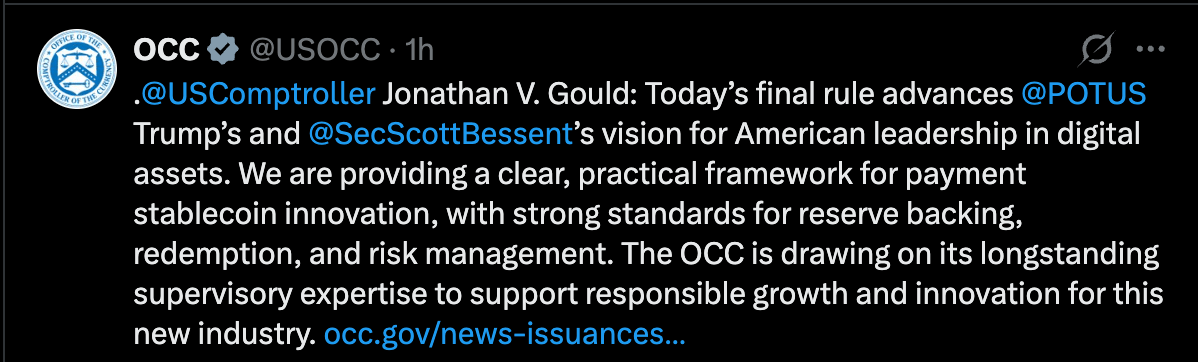
Comptroller Jonathan Gould said the rules establish standards for reserve backing, redemption, and risk management. Those statements reflect the administration’s push to expand regulated digital-asset activity in the U.S.
Stablecoin Yield Remains the Flashpoint
The most consequential provision for everyday crypto users may concern rewards.
The GENIUS Act prohibits a regulated issuer from paying interest or yield solely because a customer holds, uses, or retains its stablecoin. That applies to both retail and institutional holders.
The OCC, however, dropped a proposed presumption that could have automatically swept certain affiliate and third-party arrangements into the ban.
Instead, rewards programs and transaction-based incentives will be assessed according to their specific structure. The regulator said payments serving another genuine purpose may fall outside the prohibition, while arrangements designed to disguise issuer-funded yield could still violate it.
That distinction matters for exchanges and payment platforms offering stablecoin incentives.
January 2027 Starts a New Stablecoin Era
The rule does not finish Washington’s stablecoin work. Requirements involving the Bank Secrecy Act, anti-money laundering controls, and OFAC sanctions are being handled separately with the Treasury Department.
Still, the development is significant.
Stablecoins have spent years operating through a patchwork of state rules and regulatory interpretations. The GENIUS framework gives the sector something it has never had at this scale: a dedicated federal rulebook governing who can issue digital dollars and how those dollars must be backed and redeemed.
About the Author