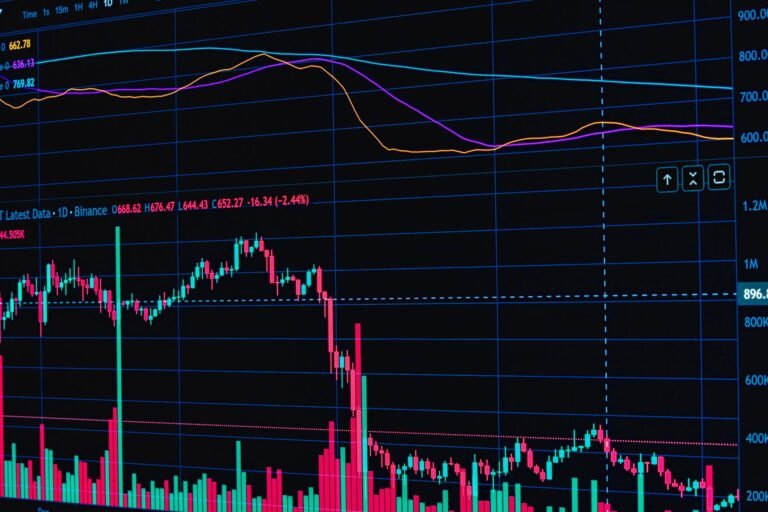
In a year marked by market turmoil, the AI and stablecoin sectors have emerged as beacons of resilience and growth, defying the broader crypto market’s downturn. While Bitcoin (BTC) and altcoins have suffered, these sectors are capitalizing on robust structural tailwinds, indicating a significant shift in the crypto landscape.
Resilient Growth in a Bear Market
The AI sector has recorded the smallest loss in Q1 2026, down just 14%, according to a recent Grayscale report. This performance stands out against the backdrop of a broader market decline, with the total crypto market capitalization slipping to $2.42 trillion. Stablecoins, meanwhile, have seen their market capitalization hit a record $320 billion, with monthly transaction volumes reaching an unprecedented $1.8 trillion.
Stablecoins: The New Financial Infrastructure
Stablecoins, designed to maintain a stable value, have become the backbone of the crypto ecosystem. Circle’s USDC, for instance, has seen a 220% increase in supply since November 2023, reaching $78 billion. USDC’s growth underscores the sector’s role in providing financial infrastructure, especially during periods of market uncertainty.
AI: Driving Innovation and Adoption
The AI sector’s growth is equally impressive, with platforms like ChatGPT seeing a 10x increase in weekly active users from 85 million in November 2023 to 900 million in March 2026. This surge in usage highlights the increasing demand for AI-driven solutions in various sectors, from finance to entertainment.
Investor Sentiment Shifts
The Grayscale report also notes a significant shift in investor sentiment. Capital is increasingly flowing into projects with strong fundamentals and those aligned with key themes such as AI and tokenization. This trend reflects a broader move away from speculative investments towards more sustainable and infrastructure-focused projects.
Structural Tailwinds and Future Prospects
Token Terminal, a crypto data provider, identifies AI labs and stablecoin issuers as businesses with the strongest structural tailwinds of the 2020s. These sectors sit at the intersection of technology, finance, and geopolitics, each independently driving demand. AI enhances productivity and defense capabilities, while stablecoins provide the financial infrastructure for global dollar distribution.
The convergence of these trends is evident in the growing integration of AI and stablecoins. For instance, AI-driven payment systems require instant and low-fee payment mechanisms, which stablecoins efficiently provide. This symbiotic relationship is likely to drive long-term growth and innovation in both sectors.
Conclusion
As the crypto market continues to navigate through a period of uncertainty, the resilience and growth of the AI and stablecoin sectors offer a promising outlook. These sectors are not just weathering the storm; they are laying the foundation for a more robust and sustainable crypto ecosystem. The transition from speculation to infrastructure is well underway, and the future looks bright for these innovative technologies.
About the Author