



Bitcoin Mining Revenue Hits 11-Month High Despite Brutal Hashprice Decline
While bitcoin prices have tumbled in the aftermath of the massive $6.3 billion Binance hack, miners closed October with their highest monthly revenue since November 2025. However, the leading crypto asset’s recent price deterioration has taken a considerable toll on mining profitability, with current hashprice figures sitting 17.54% below their levels just 30 days earlier.


Key Takeaways
- Bitcoin miners face mounting pressure as market conditions deteriorate.
- October’s mining figures reveal an unexpected financial contradiction.
- November could expose deeper vulnerabilities across the mining industry.
Bitcoin Mining Hashprice Slides 17.54% as Profit Margins Tighten
Bitcoin hashprice is a mining profitability metric that measures the estimated daily revenue generated per unit of computational power, typically expressed in U.S. dollars or satoshis per terahash or petahash per day.
On Oct. 1, 2026, each petahash per second (PH/s) of mining power generated an estimated $40.24 in daily revenue, but that figure has since dwindled to $33.18 as of Nov. 1, according to data from hashrateindex.com. The 17.54% decline is closely linked to the Binance hack and the subsequent market turmoil that battered bitcoin prices.
Despite the revenue slide, the network’s overall computational power stands at 1082.24 exahash per second (EH/s) and average block times are around 9 minutes 52 seconds. The broader cryptocurrency market downturn has yet to significantly impede mining operations, although increasingly compressed profit margins could eventually test miners’ financial resilience.
October Mining Revenue Hits $1.215 Billion Despite Bitcoin’s Market Decline
Amid these headwinds and bitcoin’s price logging a 7.3% decline in October, miners nevertheless recorded their most lucrative month since November 2025. According to monthly mining revenue records from newhedge.io covering the past 12 months, miners collectively generated $1.215 billion between Oct. 1 and Oct. 31.
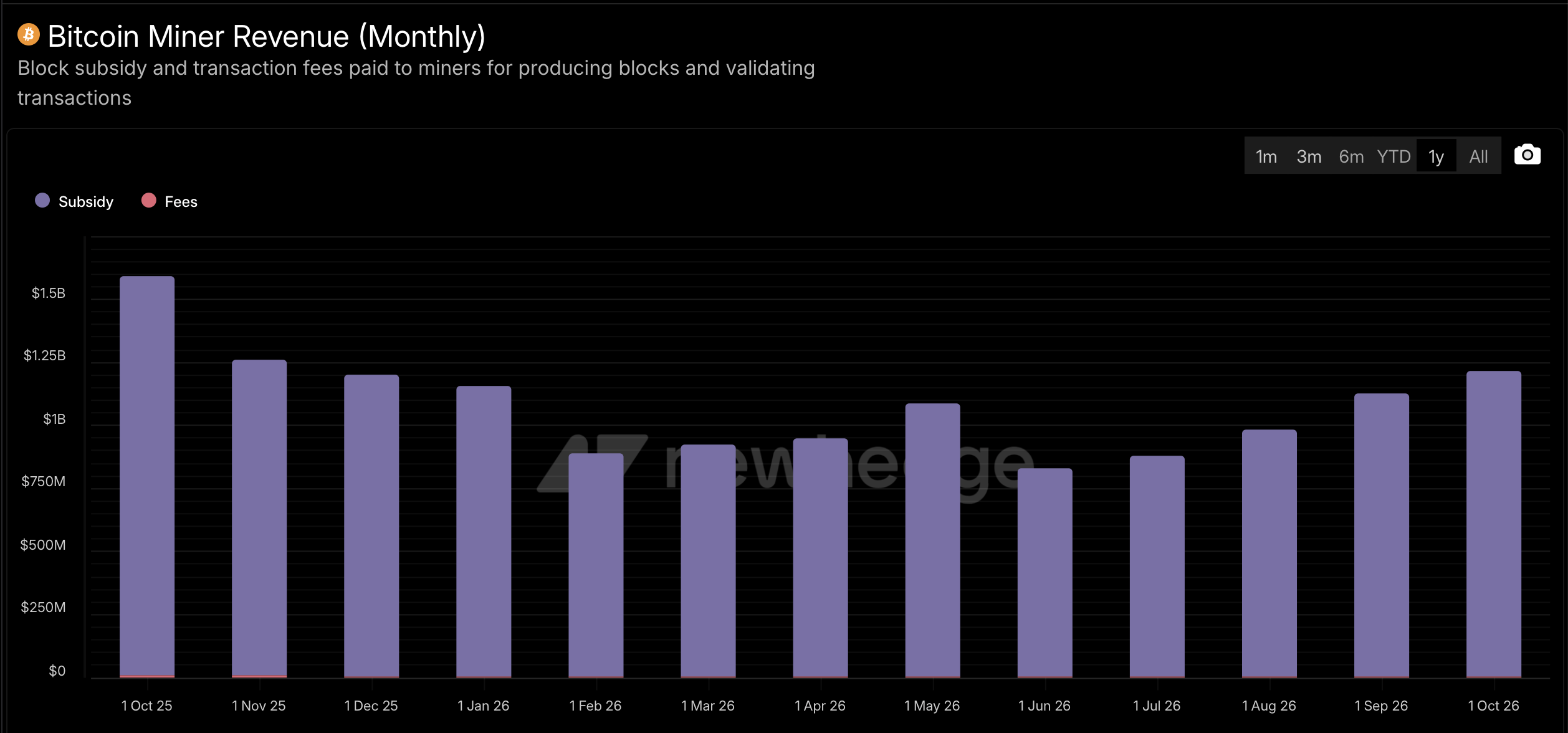
November 2025 logged a total of $1.26 billion and the following month, in December 2025, miners logged around $1.20 billion. The fact is, crypto exchange security failures primarily unsettle market sentiment, erode liquidity and weaken investor confidence, yet they leave Bitcoin’s predetermined block issuance schedule entirely intact.
Mining economics, meanwhile, follow a predictable cyclical pattern: deteriorating hashprice pushes inefficient machinery out of operation, subsequent difficulty adjustments alleviate financial pressure, and the remaining miners secure a larger proportion of block rewards.
The deeper concern for bitcoin mining is not whether the industry can withstand another market shock, but how much financial punishment operators can absorb before their business models become untenable. October proved financially rewarding for bitcoin miners, but November could tell an entirely different story.

On Oct. 29, during the Binance hack, approximately 18,270.2 BTC worth $1.4 billion was stolen, with the Federal Bureau of…
Read Now: North Korea’s $1.4B Bitcoin Haul From Binance Hack Remains Untouched


About the author
WRITTEN BYJamie RedmanNews Lead
Jamie Redman is the News Lead at Bitcoin.com News and a financial technology journalist based in Massachusetts.
About the Author