



Crypto ETFs Lose $593M in a Week as Bitcoin, Ether Selling Persists
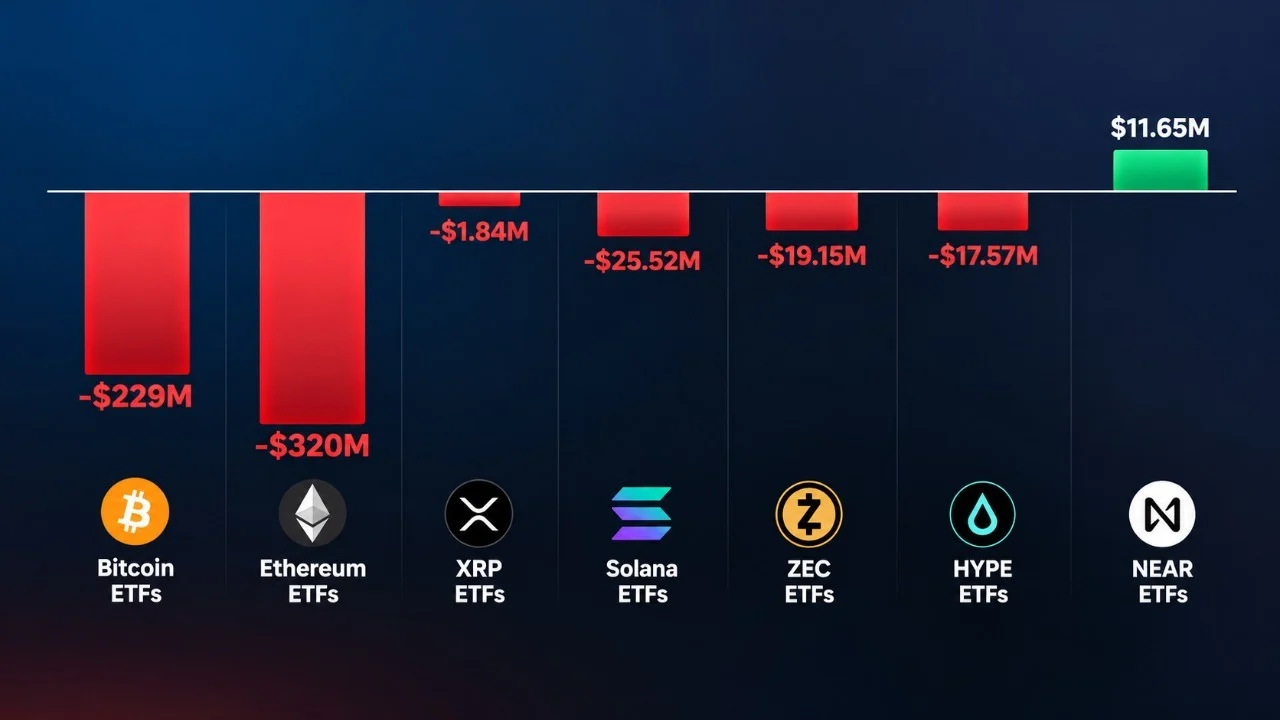
U.S. crypto ETFs remained under pressure in the week through Oct. 16, with bitcoin funds losing about $229 million and ether ETFs shedding $320 million. The pace of withdrawals eased from the previous week, yet selling spread across all major ETFs as investors continued to reduce risk.

Key Takeaways
- Crypto ETFs lost about $593M through Oct. 16, down 52% from the prior week’s $1.2B.
- Ether faced the heaviest pressure by assets under management (AUM), while solana has now logged 10 straight outflow days.
- NEAR stood apart with $11.65M of inflows as investors stayed selective and defensive.
Crypto ETF Outflows Drop 52% but All Major Funds Finish Red
The intensity faded. The caution did not.
Institutional investors pulled roughly $593 million from the five major crypto exchange-traded fund (ETF) categories last week, about 52% less than the $1.2 billion withdrawn a week earlier. Still, every category finished in negative territory.
Bitcoin ETFs lost about $228.6 million between Monday and Friday, marking another difficult week after the previous period’s $681 million withdrawal.
The path was volatile. Monday opened with a $65.40 million exit before Tuesday delivered a $175.62 million rebound. That optimism disappeared on Wednesday as $261.46 million left the funds. Thursday produced a marginal $5.06 million inflow, followed by an $82.39 million exit Friday.
Blackrock’s IBIT accounted for $165.4 million of weekly redemptions, while Fidelity’s FBTC lost $60.2 million. Morgan Stanley’s MSBT attracted $6.7 million.
Ethereum Carries the Heavier Burden
The relative scale of the withdrawals tells a more important story.
Bitcoin ETF assets ended the week at $104.29 billion. Weekly outflows represented only around 0.22% of that base.
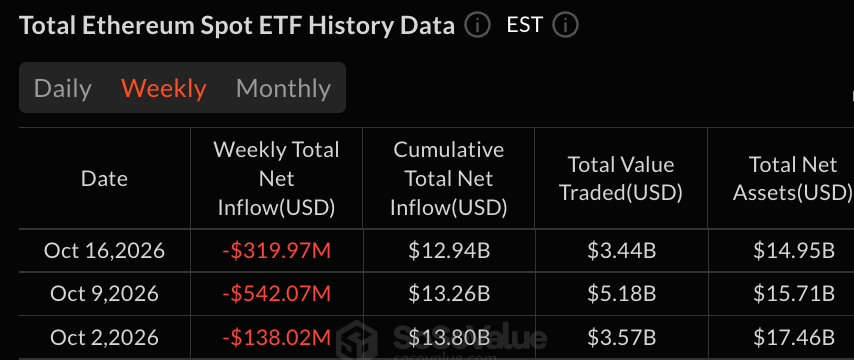
Ether ETFs closed with $14.95 billion in assets after losing roughly $320 million, equivalent to about 2.14% of AUM. That means ether faced close to 10 times the redemption pressure experienced by bitcoin relative to fund size.
Ether also recorded its third consecutive negative week.
Tuesday’s $24.84 million inflow briefly ended a 10-day losing streak. However, the reprieve lasted one session. Ether funds lost $129.51 million on Wednesday, $60.22 million on Thursday, and then $69.68 million on Friday.
Trading activity cooled at the same time. Bitcoin ETF turnover declined to about $10.11 billion from $11.44 billion, while ether volume fell roughly 34% to $3.44 billion.
The combination of lower turnover and persistent redemptions suggests institutional enthusiasm for crypto remains restrained.
Solana’s Institutional Retreat Deepens
Solana ETFs delivered another important warning signal.
Funds lost $25.52 million last week, slightly exceeding the previous week’s record $24.81 million outflow. That pushed two-week withdrawals to approximately $50.33 million.
Solana products have now recorded 10 consecutive trading days of net outflows. ETF assets fell to $1.62 billion, making weekly redemptions equal to roughly 1.58% of AUM. SOL itself declined about 4.6% during the week.
The figures mark a dramatic shift for a category that had previously enjoyed 14 straight weeks of institutional inflows.
XRP ETFs lost a modest $1.84 million, while HYPE products recorded $17.57 million in weekly redemptions. Zcash funds shed $19.15 million as the post-launch enthusiasm continued to fade.
NEAR Remains the Exception
NEAR once again moved against the prevailing current.
Bitwise’s NRR attracted $11.65 million during the week, including inflows on Monday, Tuesday, Thursday, and Friday. It remains one of the few newer products to draw capital consistently during the broader risk reduction.
The macro environment helps explain the defensive positioning.
September CPI accelerated to 3.7% annually, while producer prices rose 6.3%. Higher energy costs added further inflation pressure and strengthened the case for restrictive Federal Reserve policy.
That backdrop has weighed on bitcoin’s price and other risk assets.
The encouraging signal is that the speed of ETF withdrawals has slowed considerably. The harder question is whether that stabilization can survive another round of inflation-driven rate repricing.
For now, institutional capital remains engaged, though increasingly defensive and selective about where it stays invested.

Bitwise CIO Matt Hougan argues that bitcoin could benefit across radically different AI-driven economic outcomes, from a productivity boom to…
Read Now: Bitcoin Can Win Whether AI Boom Continues or Crashes: Bitwise CIO


About the Author