
Written by Martin Youngstaff writerReviewed by Felix Ngstaff editor
Excessive AI spending risks global financial consequences, BIS warns
The AI investment surge is a potential flashpoint for systemic risk, “as financing has relied on enormous debt and highly leveraged nonbank structures that can rapidly unwind,” one analyst said in response to the report.
The Bank for International Settlements has warned that artificial intelligence “exuberance” could have major financial consequences, as heavy reliance on debt financing in AI ventures raises the risk of cascading defaults if investor optimism fades.
The five largest hyperscalers are set to spend more than $1 trillion on AI-related capital expenditures from 2025 through 2026, and these commitments are outpacing earnings, the Basel-based institution said in its annual economic report released Sunday.
“Equity valuations are elevated, particularly for firms at the core of AI development … sustaining such high growth could become increasingly challenging,” the bank said.
AI investment enthusiasm has surged with the recent SpaceX IPO and planned public offerings from Anthropic and OpenAI, leading some market observers to draw parallels to previous boom-bust cycles such as electrification exuberance in the late 1920s and the dot-com bubble in the late 1990s.
The global economy displayed “surprising resilience” in 2025 despite successive shocks, partly driven by AI investments, the bank said.
However, “perils have grown” in 2026, with concerns over the risks of persistent inflation, which rose to a three-year high of 4.2% in the US in May, according to TradingEconomics.
The sustainability of AI-related investments, “growing financial vulnerabilities and weakening fiscal positions,” has added to those perils, the BIS report said.
“Should inflation rise significantly or AI-led investment turn to a bust, the macroeconomic consequences could be amplified by existing financial vulnerabilities.”
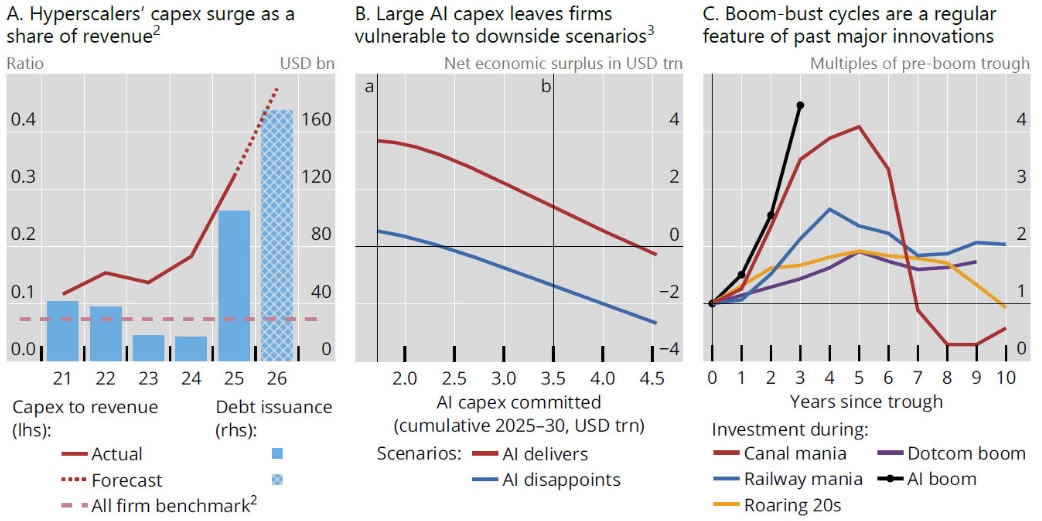
Rapid AI boom raises questions about its sustainability. Source: BIS
If central banks tighten policy to contain inflation, this could precipitate a “sharp pullback in [AI] asset prices after a prolonged period of exuberant risk-taking,” which could trigger “disruptive macro-financial feedback loops,” the BIS said.
“A reversal of AI optimism could likewise have major financial consequences, given AI firms’ rising leverage and growing footprint in credit markets.”
A potential flashpoint for systemic risk
The BIS cautioned that a large correction in AI valuations could have more pronounced wealth effects and a “sharper consumption pullback” than in the past, given US market dominance. “Financial stability could also be at risk in the event of an AI bust.”
Related: AI agents with crypto could escape and become ‘unstoppable,’ experts warn
Nick Ruck, director of LVRG Research, told Cointelegraph that the BIS was right to flag the AI investment surge as a potential flashpoint for systemic risk, “as financing has relied on enormous debt and highly leveraged nonbank structures that can rapidly unwind and amplify this cycle into a crisis.”
“The current macroeconomic environment is already fragile from being stretched by inflation, record national debt, and disrupted commodity markets, so a bust of the AI capital stack could send shockwaves through an already strained global economy.”
The BIS also cautioned about stablecoins, which risk fragmenting the global monetary system and could weaken sovereign monetary control, it said.
Chipflation could compound the problem
The AI industry could also become a victim of its own success, as surging semiconductor and memory chip prices, driven by increasing AI data center demand outstripping supply, could compound inflation, which consumers will ultimately have to bear.
This phenomenon, known as “chipflation,” is causing prices for devices from smartphones to laptops to climb, Morgan Stanley analysts cautioned earlier in June.
In March, BlackRock reported that surging semiconductor prices were “posing upside risks to global goods inflation.”
Meanwhile, Apple is already passing costs on to customers by hiking prices. The tech giant announced Thursday that a wide array of products, from iPads to Macs and home devices, would see increases from 18% to nearly 33% due to soaring memory and storage chip costs.
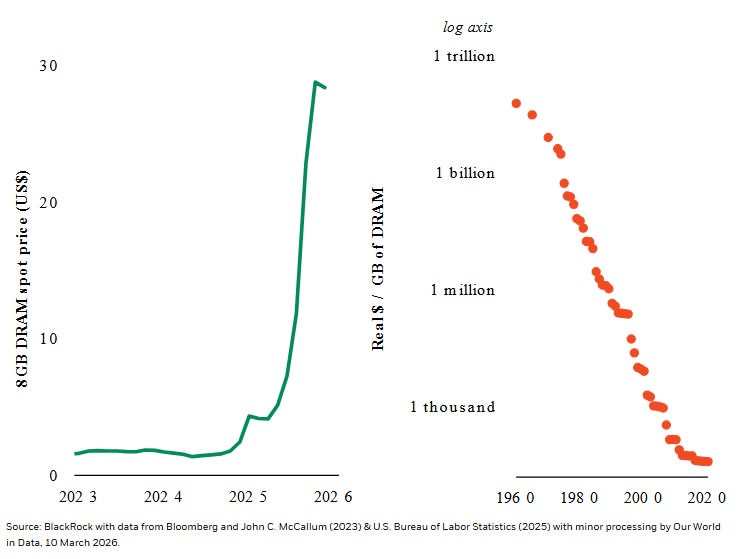
Price jumps for DRAM chips defy deflationary price dynamics. Source: BlackRock
Magazine: AI is banking the unbanked in Africa… faster than crypto
More on the subject
About the Author