




Gold Bugs Meet Their Worst Nightmare: A Machine That Prints Gold
A San Francisco startup claims it has turned mercury into real gold, beating CERN’s production rate by ten times. The nuclear feat comes as gold trades just under $4,000 an ounce, roughly 26% below its January peak, raising questions about future scarcity.


Key Takeaways
- Marathon Fusion claims it converted mercury into stable gold, beating CERN’s production rate by ten times.
- Gold closed near $3,996 on Oct. 23, approximately 26% below its January peak amid broader market weakness.
- World Gold Council estimates put above-ground gold stocks at 222,600 tonnes, dwarfing laboratory production.
Marathon Fusion Claims a Breakthrough in Gold Production
Marathon Fusion announced this week that it had demonstrated a process for converting mercury into stable gold, using nuclear reactions rather than the mythical chemistry pursued by medieval alchemists.
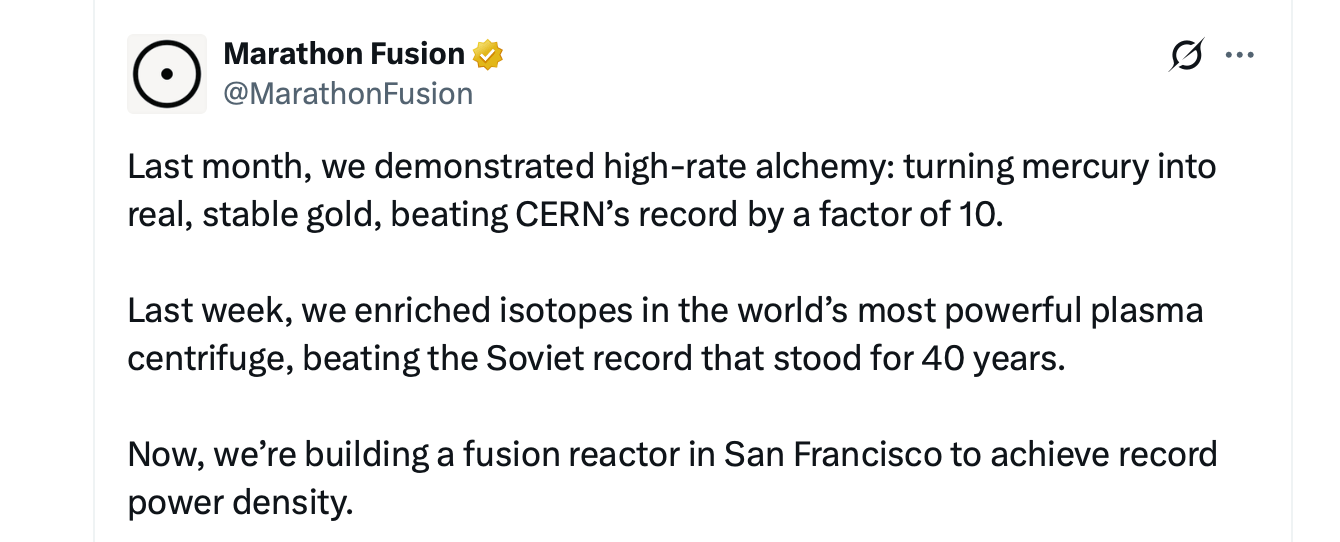
The company, founded in 2023, shared gamma-ray measurements it said supported the experiment. However, according to several reports, including from the Financial Times (FT), Marathon Fusion hasn’t disclosed how much gold it produced, what it cost, or whether anyone independently verified the results.
The physics isn’t science fiction. Marathon’s July 2025 research proposed bombarding mercury-198 with high-energy neutrons inside a fusion reactor, creating mercury-197, which subsequently decays into gold-197, the stable isotope found in jewelry, coins, and central-bank vaults. Its simulations projected approximately two tonnes of gold annually per gigawatt of thermal fusion power. That’s theoretical industrial output, not demonstrated production.
CERN’s Gold Experiment Sets a Microscopic Benchmark
Marathon’s claim of beating CERN by 10 times sounds extraordinary until the original benchmark enters the picture. In 2025, CERN researchers reported that lead collisions at the Large Hadron Collider generated approximately 86 billion gold nuclei between 2015 and 2018. Their combined mass amounted to just 29 picograms, or 29 trillionths of a gram.

Even multiplying that quantity by 10 yields only 290 picograms, although Marathon’s production-rate comparison doesn’t establish its actual output. Neither experiment demonstrated commercially viable gold production. Radioactive byproducts, costly equipment, and complex isotope separation present additional obstacles.
Gold Trades Below $4,000 as Supply Questions Emerge
The scientific claim arrives during a difficult stretch for gold investors. The precious metal finished Friday, Oct. 23, near $3,995 per troy ounce, down approximately 0.7% on the day and 4% over the week. The monthly picture looks equally discouraging, with gold shedding approximately 6.5% to 7% over 30 days and roughly 7.5% to 8.5% since the beginning of 2026.
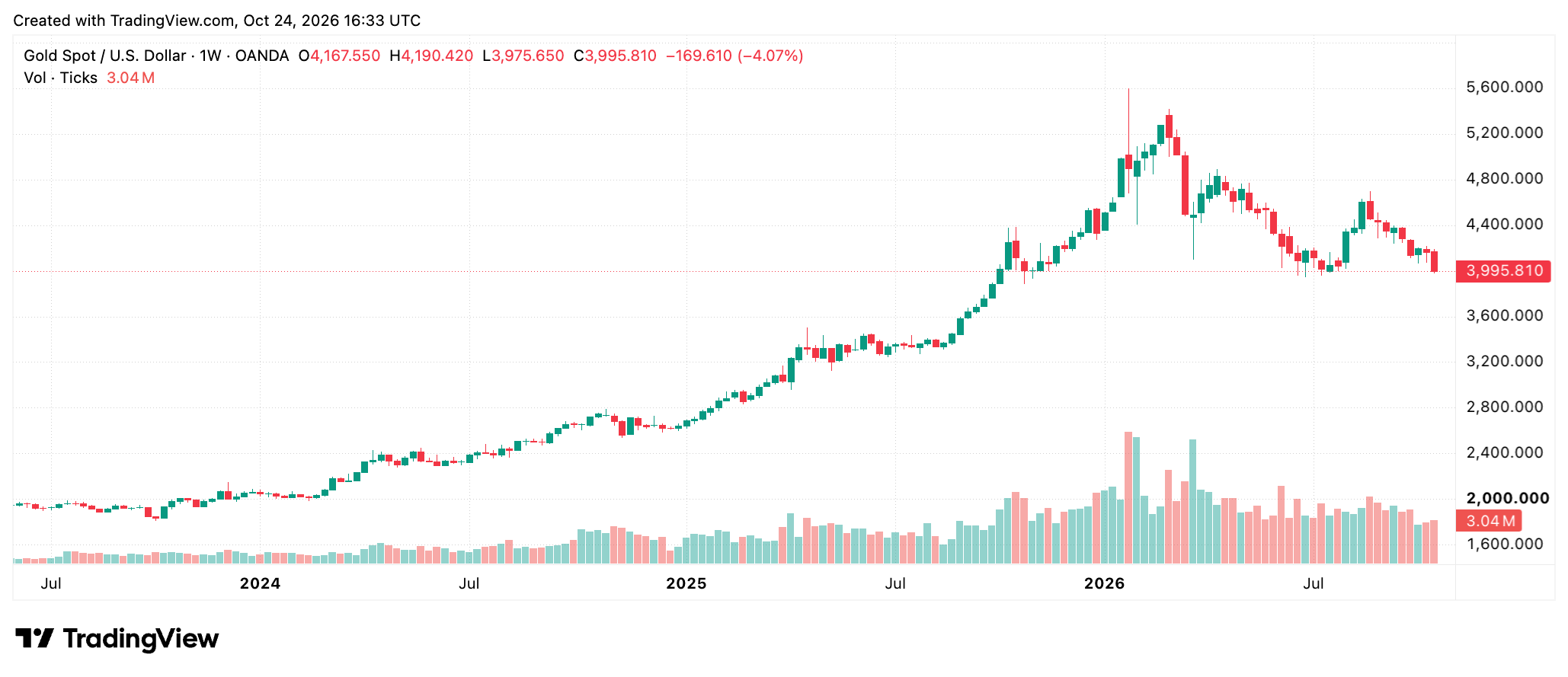
Gold prices have retreated approximately 26% from their late-January peak near $5,400 to $5,600, pressured by elevated Treasury yields, higher oil prices and expectations of prolonged restrictive Federal Reserve policy. Despite the recent selling, gold remains more than 120% higher over five years. Meanwhile, the World Gold Council estimates above-ground stocks at approximately 222,600 tonnes, representing roughly 60 years of current annual mine production.
Global mining output reached approximately 3,672 tonnes in 2025. Matching that annual supply through Marathon’s proposed process would require approximately 1,800 gigawatts of thermal fusion capacity, assuming its theoretical yields hold.
Commercial fusion plants don’t yet operate at that scale, and the economics of synthetic gold remain unproven. Even if the process eventually becomes commercially viable, the resulting metal would be chemically indistinguishable from naturally mined gold.
Bitcoiners Troll Gold Bugs Over Marathon Fusion’s Breakthrough
Bitcoin proponents, meanwhile, have seized on Marathon’s announcement to needle longtime gold advocates, arguing that the ability to manufacture gold exposes a fundamental weakness in the precious metal’s scarcity narrative. Some have drawn comparisons to laboratory-grown diamonds, while others have joked about funding fusion research to undermine gold’s monetary premium. Real, earth-crafted diamonds have seen a 50% drop in value since the introduction of lab diamonds.

The argument has also revived the familiar rivalry between bitcoin supporters and gold advocate Peter Schiff, with Bitcoiners pointing to the network’s 21 million coin supply limit as a distinction. Gold defenders counter that theoretical production and economically viable manufacturing are entirely different propositions, leaving the age-old debate over which asset represents harder money far from settled.
For now, gold’s immediate challenge comes from financial markets, not nuclear alchemy. The real question is whether manufacturing a marketable ounce will ever cost less than buying one.

Chamath Palihapitiya once predicted bitcoin would reach $1 million. Now he says artificial intelligence (AI) will eventually hack the Bitcoin…
Read Now: Chamath Palihapitiya Warns Bitcoin Will Hit Zero After Years of Bullish Calls


About the Author