



Hong Kong Just Put Hyperliquid on Its Suspicious Exchange List
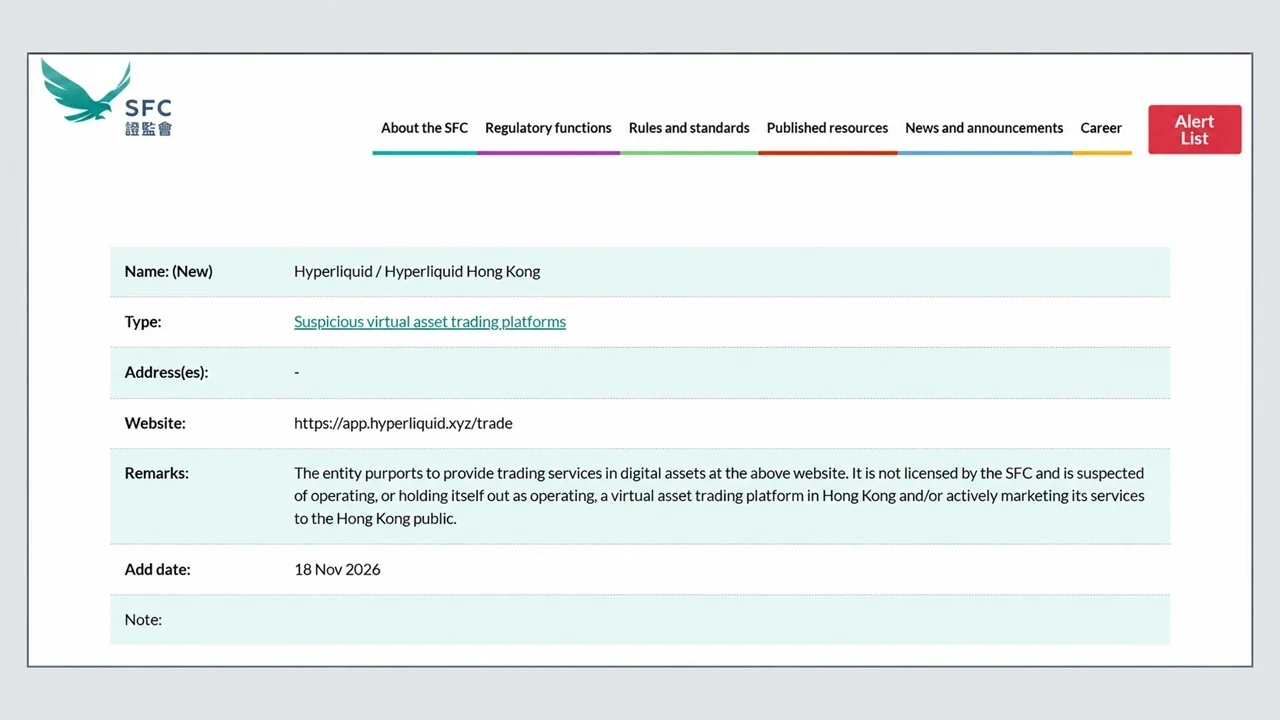
Hong Kong’s Securities and Futures Commission (SFC) added Hyperliquid to its list of suspicious virtual asset trading platforms on Nov. 18, flagging the decentralized derivatives giant as unlicensed in the city.

Key Takeaways
- The SFC listed Hyperliquid and Hyperliquid Hong Kong on Nov. 18, naming its web trading app as the site.
- It is the exchange’s second Asian warning in five months after Singapore’s MAS flagged it on June 26.
- HYPE us trading near $65 on Nov. 20, about 34% below its Sept. 23 record of $97.96.
The Scoop
The entry sits at the top of the SFC’s suspicious platforms list with a red “(New)” tag. It names both “Hyperliquid” and “Hyperliquid Hong Kong” and gives the exchange’s web trading app, app.hyperliquid.xyz/trade, as the website in question. The regulatory body further highlighted:
[The entity] purports to provide trading services in digital assets at the above website. It is not licensed by the SFC and is suspected of operating, or holding itself out as operating, a virtual asset trading platform in Hong Kong and/or actively marketing its services to the Hong Kong public.
Second Warning in Five Months
Hong Kong is not the first Asian financial hub to put the exchange on a watch list, as in June of this year, the Monetary Authority of Singapore (MAS) also added Hyperliquid to its Investor Alert List, naming both the Hyper Foundation website and the trading app.
Hyperliquid pushed back at the time, stating:
“IAL listing does not constitute a ban, an enforcement action, or a finding of wrongdoing,”
A representative for the exchange further added that it had never represented itself as holding MAS authorization.
In the SFC’s case, it has called its listing an “early warning service to investors” covering entities that “are unlicensed in Hong Kong and are believed to be, or to have been, targeting Hong Kong investors.”
To put it simply, the Hyperliquid entry is simply a warning, one that carries no stated fine, asset freeze, or court order.
Who Else Is on the SFC’s Hit List
Hyperliquid lands in mixed company as the page holds a total of 69 entries (added since January 2020), ranging from copycat websites impersonating the licensed Hashkey Exchange to offshore brokers.
The entry directly before Hyperliquid’s belongs to the centralized exchange BTCC, added Oct. 22. The SFC says the entity is run by BTCC Poland Limited and is “suspected of conducting unlicensed activities in Hong Kong.”
On the other side of the ledger, only 13 platforms hold full SFC trading licenses, from OSL and Hashkey Exchange to Bullish and Bixin.com, according to the regulator’s licensed platforms register, last updated Oct. 16. Big names such as Crypto.com operator Foris DAX HK still sit on the applicants list.
The SFC’s message to traders on unlicensed venues is clear, stating:
You may lose your entire investment held on the VATP if it ceases operation, collapses, is hacked or otherwise suffers from any misappropriation of assets. Legal remedies may not be available.
The Size of the Target in Question Is Immense
Hyperliquid is no fringe venue, having closed its third quarter with a record $16.8 billion in open interest, up nearly 80% from the end of June (overtaking Bybit, Kraken and OKX, in the process). Its share of open interest across itself and eight major exchanges too has climbed to 11.7%, with daily traders averaging a record 65,161, and protocol revenue reaching nearly $191 million.
That reach has drawn scrutiny elsewhere too, and this week, a former Robinhood engineer pleaded guilty to wire fraud. That said, HYPE, the exchange’s native token, is changing hands near $65, down 4.2% on the day and 7.7% over the week. That leaves it about 34% below its Sept. 23 all-time high of $97.96.

A former Robinhood software engineer has pleaded guilty to wire fraud for trading perpetual futures on Hyperliquid ahead of Robinhood’s…
Read Now: Ex-Robinhood Engineer Admits to $125K Hyperliquid Front-Running Scheme


About the author
WRITTEN BYShiraz JagatiCrypto Reporter
Shiraz is a journalist and analyst whose work has covered the digital asset arena and blockchain-related developments since 2016.
About the Author