




IBS Token Crashes to Zero After $5.72M Pots Money Exploit
Decentralized finance (DeFi) protocol Pots Money suffered a $5.72 million exploit on Saturday, Nov. 28, after a privileged governance account minted 101 billion IBS tokens, effectively destroying the cryptocurrency’s market.

Key Takeaways
- Pots Money’s IBS/USDT liquidity pool lost 5,724,519 USDT in just 62 seconds.
- Defillama’s data indicates roughly $8.8 billion in crypto-related losses throughout 2026.
- Anthropic researchers reproduced 207 historical smart-contract exploits using AI models.
Pots Money Exploit Leaves IBS Token Practically Worthless
Blockchain security firms Blockaid and Peckshield identified the exploit on BNB Chain after a privileged governance account exercised its minting authority to create enormous quantities of IBS tokens. The newly issued coins were subsequently sold through the decentralized exchange (DEX) Pancakeswap V2.
At 4:47 a.m. UTC, the first transaction introduced 1 billion IBS tokens, extracting 5,710,306.09 USDT from the liquidity pool. Just 62 seconds later, another 100 billion IBS tokens were minted and exchanged for an additional 14,212.91 USDT, leaving approximately 76 USDT in the pool.
“A privileged governance account minted 1 billion IBS tokens into the IBS/USDT pool and swapped them for USDT, emptying the pool,” Blockaid reported at the time.
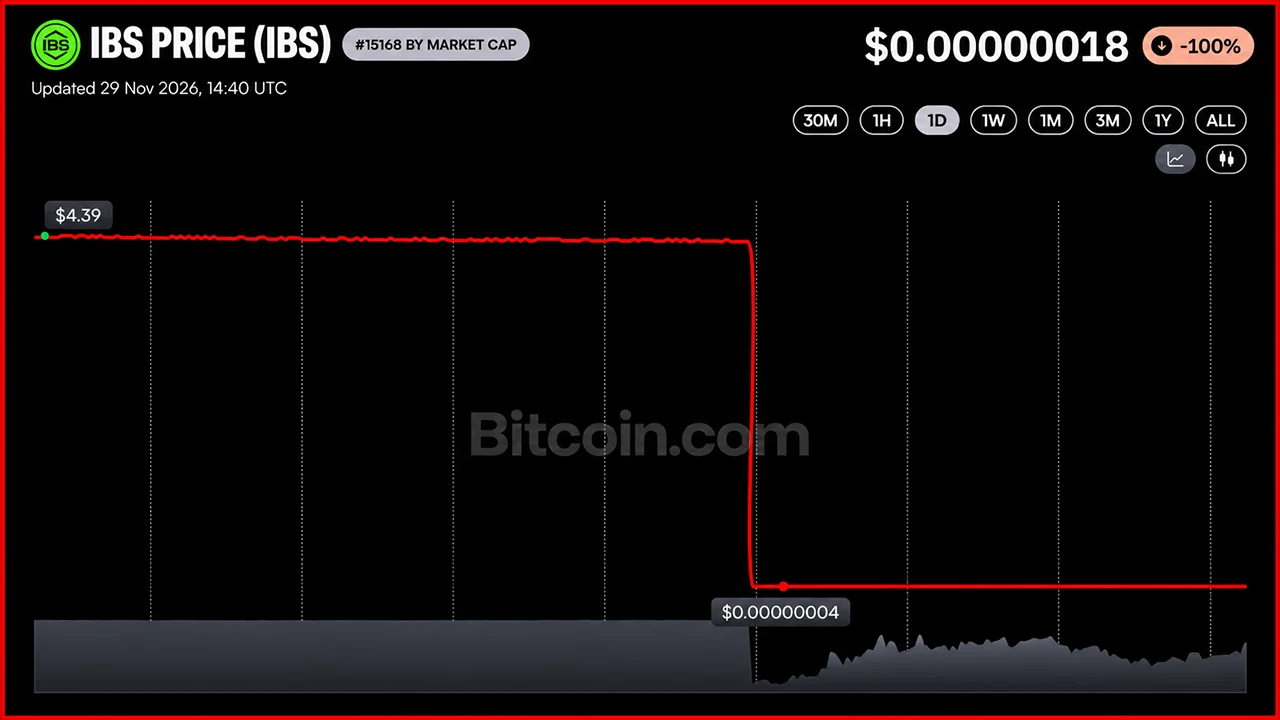
Peckshield subsequently traced the proceeds to a wallet identified as “0x25D21c…ccceD2.” Meanwhile, IBS, which previously traded around $4.40, plunged to approximately $0.00000008. Digital asset market aggregators had listed the token’s pre-exploit circulating supply at roughly 871,020 IBS.
Unlike conventional smart-contract exploits involving flash loans or reentrancy vulnerabilities, the Pots Money incident revolved around existing administrative permissions. Locked liquidity offered little protection because the funds were extracted through swaps rather than direct liquidity withdrawals.
Pots Money had positioned itself as an algorithmic monetary system, describing its architecture as “the Federal Reserve of DeFi, running on code.” Its documentation maintained that “no single actor can compromise the protocol.”
Whether the governance account was compromised externally or exploited by an insider remains undetermined. At the time of initial reporting, Pots Money had not publicly disclosed a recovery strategy or reimbursement plan.
Crypto Security Breaches Mount as 2026 Draws to a Close
The IBS incident arrives during an exceptionally costly year for digital asset security. Defillama’s records indicate approximately 372 incidents through late November, with cumulative losses approaching $8.837 billion. However, that figure is heavily influenced by the massive $6.36 billion Binance theft in October, illustrating how individual infrastructure breaches can distort aggregate industry statistics.
Hacken recorded $1.18 billion in losses across 107 incidents during the third quarter, representing a 55% increase from the preceding quarter. Certik’s assessment placed third-quarter losses at approximately $1.26 billion across 247 incidents, reflecting differences in reporting methodologies.
The frequency of smaller smart-contract exploits presents another concern, particularly as increasingly sophisticated AI agents lower the technical and financial barriers to discovering software vulnerabilities.
AI-Assisted Coding and Defi Hacks Reach a Fever Pitch
Research from Anthropic’s Frontier Red Team examined 405 historically exploited smart contracts, with AI models successfully reproducing 207 exploits representing $550.1 million in simulated funds. Researchers also identified two previously undiscovered vulnerabilities among 2,849 recently deployed contracts.
Independent research from Defillama and Firepan yielded similarly concerning results. Its examination of 1,040 historical onchain defi incidents classified 68% as both discoverable and exploitable using AI and publicly available pre-exploit code. Nevertheless, smaller incidents proved more susceptible to automated reproduction. The median loss among reproducible exploits stood at approximately $545,000, compared with $3.3 million for incidents classified as nonreproducible.
AI-assisted software development introduces another dimension to the security equation. Research examining automated coding agents found vulnerabilities in 72% to 83% of functionally successful outputs in one evaluation, raising questions about the proliferation of hastily developed, AI-generated software.
Defenders are also embracing the technology. Bug bounty platform Immunefi recorded a 136% year-over-year increase in crypto vulnerability submissions between January and September 2026, with valid reports roughly doubling.
Privileged Access Remains Crypto’s Achilles’ Heel
Despite advances in automated vulnerability discovery, documented evidence of attackers employing AI remains comparatively scarce. Nothing disclosed about the Pots Money exploit establishes that artificial intelligence facilitated the incident.
Many of 2026’s largest crypto losses have instead involved compromised keys, infrastructure weaknesses, signer failures, and operational security deficiencies. AI may accelerate vulnerability discovery, but administrative authority remains an exceptionally consequential point of failure. The Pots Money incident demonstrates why conventional audits and liquidity locks alone cannot guarantee economic security.
Continuous monitoring, multisignature authorization and timelocks offer additional safeguards, but their effectiveness depends on implementation. As automated security research becomes increasingly inexpensive, the distinction between decentralized architecture and centralized authority may become one of defi’s most consequential security considerations.
Since the incident began, IBS, the native, algorithmic token of Pots Money, has shed 100% of its USD value.

This editorial is from this week’s edition of the newsletter Week in Review, sent to subscribers on Friday. Subscribe to…


About the author
WRITTEN BYJamie RedmanNews Lead
Jamie Redman is the News Lead at Bitcoin.com News and a financial technology journalist based in Massachusetts.
About the Author