The Device in Your Junk Drawer Contains Real Gold. Scientists Just Found a Way to Get It Out With Cheese Waste
ETH Zurich researchers led by professor Raffaele Mezzenga developed a whey-protein amyloid aerogel that pulls gold ions out of acid-dissolved electronic waste. In lab tests, the team recovered a 450-milligram nugget of 22-carat gold from metal parts taken from 20 old computer motherboards, with the work published in 2024 in Advanced Materials. The timing matters as global e-waste hit about 61.3 million tons in 2023.

Key Takeaways
- ETH Zurich recovered a 450 mg 22-carat gold nugget from 20 motherboards in 2024.
- Raffaele Mezzenga’s whey aerogel could lower e-waste recycling costs by up to 50x.
- With 61.3M tons of e-waste in 2023, Advanced Materials spotlights scalable recovery.
That old phone or dead laptop you keep meaning to recycle is richer than most gold ore, at least on a per-ton basis. In March 2024, researchers at ETH Zurich led by Professor Raffaele Mezzenga showed they could pull gold ions out of an acid-dissolved electronics cocktail using a sponge made from whey protein, a cheesemaking byproduct, dried into a porous aerogel. In a lab run using metal parts from 20 discarded computer motherboards, the team recovered a 450 milligram nugget of 22-carat gold, work later published in 2024 in Advanced Materials. The timing matters because the pile keeps growing: global e-waste hit about 61.3 million tons in 2023.
Turning food waste into a materials breakthrough
So what does a cheese byproduct have to do with your old laptop? Back in March 2024, researchers at ETH Zurich sketched a surprisingly direct answer: use leftover whey proteins to pull gold out of dissolved electronics, a twist on recycling that reads like kitchen chemistry but targets a very modern pileup of devices.
The team was led by Professor Raffaele Mezzenga in ETH Zurich’s Department of Health Sciences and Technology, with senior scientist Mohammad Peydayesh among the study’s authors. ETH Zurich laid out the approach in its March 2024 news release, after the paper appeared in the journal Advanced Materials in 2024.
A sponge that prefers gold
The core trick is a protein “sponge” made from whey. Researchers denature whey proteins under acidic conditions and high temperatures, forming protein nanofibrils, then dry them into a highly porous amyloid aerogel that can selectively adsorb gold ions from a mixed-metal solution.
In lab testing, the aerogel showed a gold adsorption capacity of 166.7 milligrams of gold per gram of aerogel, per an ADS abstract of the work. One industry report also described the method as capturing 93% of gold from solution, with the loaded sponge reaching about 20% of its own weight in gold.
From 20 motherboards to a small nugget
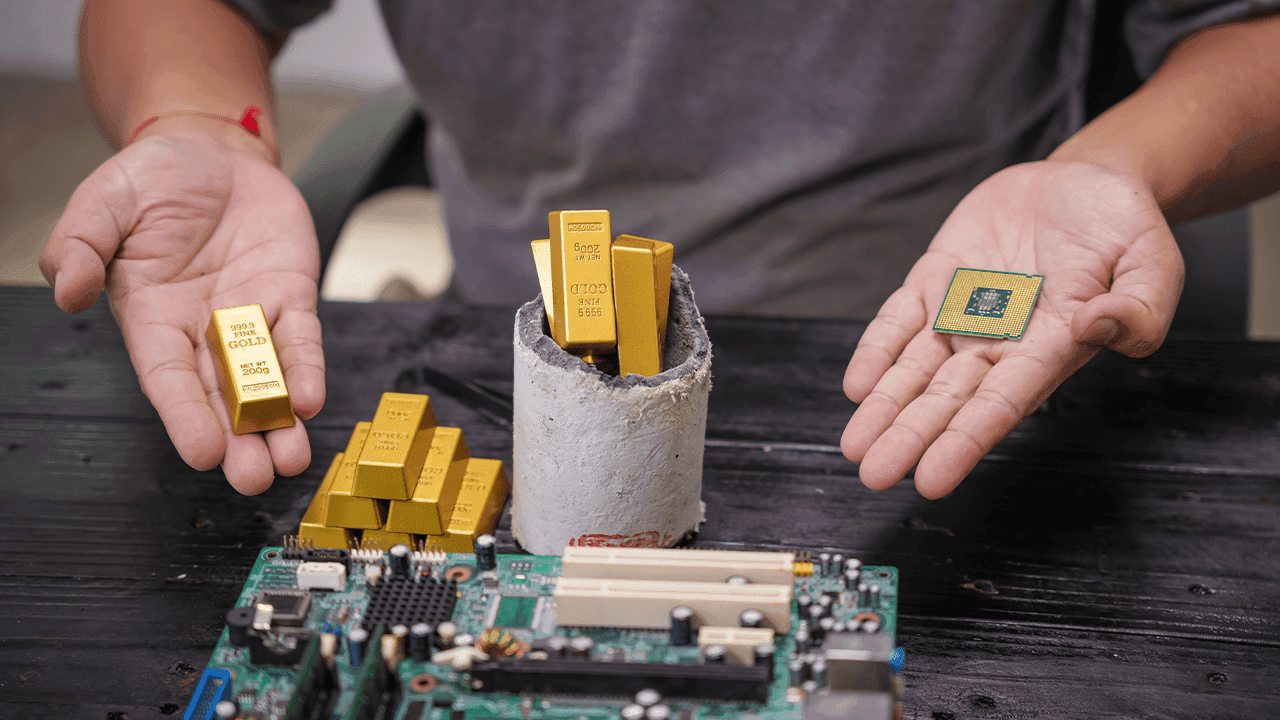
To demonstrate the process, the ETH Zurich team salvaged metal parts from 20 old computer motherboards, then dissolved them in an acid bath to ionize the metals before exposing the solution to the whey-based sponge.
The result was tangible: a 450-milligram nugget of 22-carat gold recovered from those 20 boards. It is a small mass, but it’s the kind of proof point recyclers and materials scientists watch closely because it shows selectivity in a messy, real-world mix.
Why this matters for the US e-waste mountain
The gold argument hinges on concentration. Industry reporting has described e-waste as containing up to 100 times more gold per ton than material pulled from gold mines, making discarded electronics an “urban mine” in the literal sense.
Scale is the other pressure: global e-waste generation was estimated at 61.3 million tons in 2023, a figure cited in coverage of the work by Anthropocene Magazine. Mezzenga framed the inputs plainly, saying, “our approach uses food by-products, so the starting raw materials are extremely inexpensive and sustainable.” His calculations also suggested procurement and energy costs were 50 times lower than the value of the recovered gold, and the process avoids cyanide and mercury.
Tags in this story
About the Author