
Bitcoin Magazine
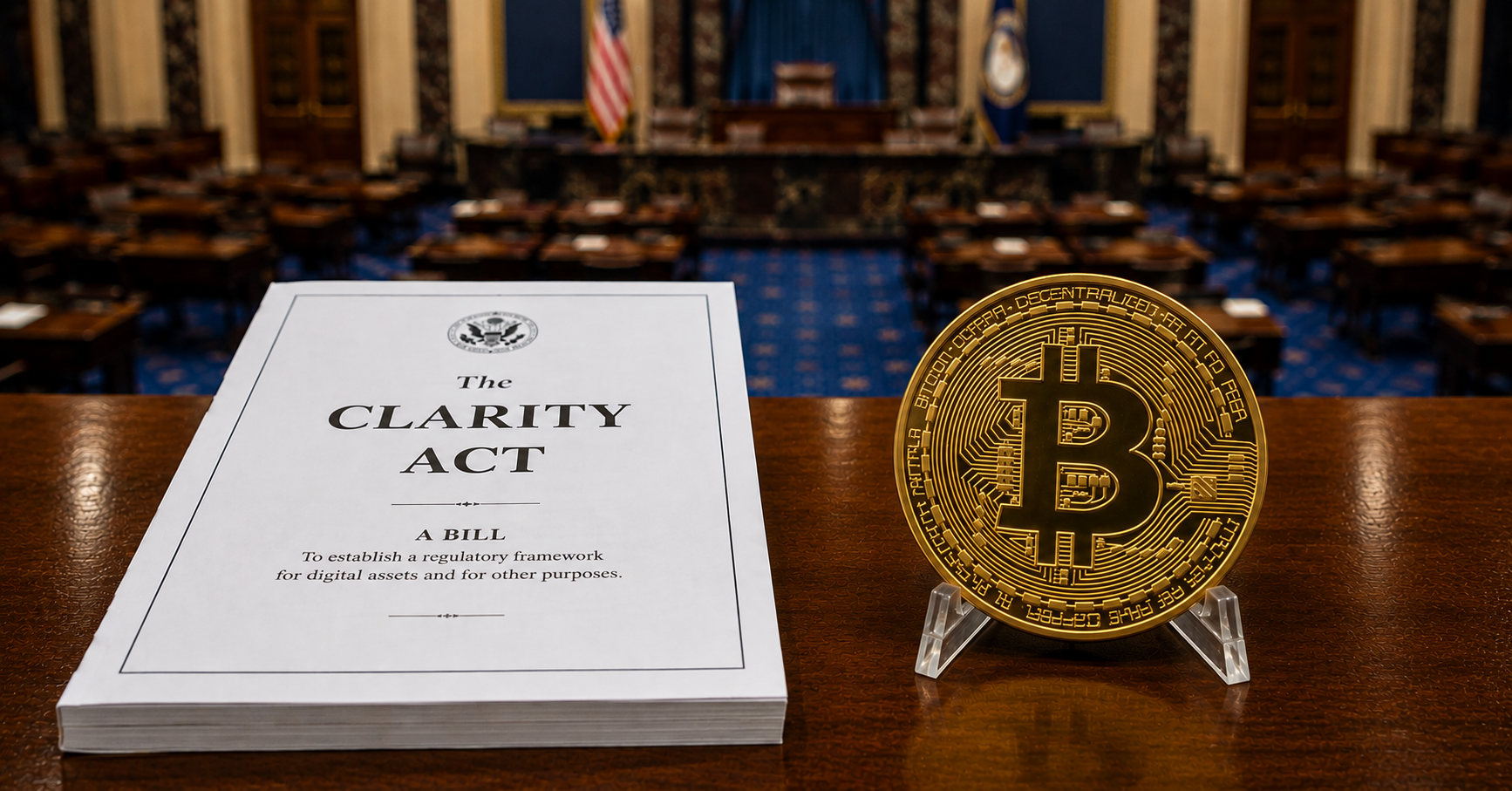
What the CLARITY Act Actually Does for Bitcoin
In July 2025, House Republicans staged a coordinated three-bill blitz they called ‘Crypto Week;, advancing the GENIUS, CLARITY, and the Anti-CBDC Surveillance State Act in the same five day stretch. The GENIUS Act was signed into law within 24 hours, creating a regulatory framework for dollar-backed stablecoins. However, the other two bills weren’t so lucky. The Anti-CBDC Surveillance State passed the House by an extremely narrow margin, and got stuck in Senate purgatory without a floor vote in place for over a year.
Following the House’s bipartisan passage of the CLARITY Act, the bill landed in the Senate Banking Committee where it sat for nearly a year. When the bill finally emerged out of committee, its cover page included the phrase “Strike out all after the enacting clause and insert the part printed in italic.”
Translation: 100% of the bill had been rewritten.
If you pull up the bill on Congress’ website today, you can see that the first 256 pages (the entire House-passed bill) are struck through, line by line, top to bottom. Then, starting on page 257, the Senate’s new version of the bill begins. (This is still the official text on file; a further-updated draft has circulated since, but hasn’t been formally filed as an amendment.)
Given how much the bill has changed shape, it’s worth taking a step back and assessing how the CLARITY Act, in its post-June 1st form, actually affects Bitcoin, and if it can truly “act as the catalyst for the next bull run” as I see so often on X today.
What the bill does do for Bitcoin
Self-custody becomes a legally protected right
Section 605, the ‘Keep Your Coins Act’, prohibits federal regulators from restricting or impairing a person’s ability to self-custody for any lawful purpose. Self-custody currently has no statutory backing, and providing direct legislation creates a defense against future tyrannical powers requiring custodial intermediaries.
While people often dismiss this threat as ‘fear mongering’ and ‘doomerism’, this type of overreach does have recent historical precedent. In 2020, Treasury Secretary Steven Mnuchin directed FinCEN to propose a rule targeting “unhosted wallets”. It would have required exchanges to collect names and home addresses for anyone moving more than $3,000/day into their private wallet, and file reports to FinCEN for anything over $10,000/day. Although the rule ultimately lost momentum, it remained on the books and un-withdrawn for almost four years. During that period, any Treasury Secretary could have revived and finalized it without any new legislation.
This is the exact scenario Section 605 is written to prevent from happening again.
Bitcoin developers, node operators, and non-custodial wallet makers get explicit immunity from money-transmitter liability
Section 604, Blockchain Regulatory Certainty Act, says a “non-controlling” developer or provider can’t be classified as a money transmitting business for doing that. Prime examples are Samourai Wallet and Tornado Cash. Both were open-source, non-custodial projects whose developers were criminally prosecuted under the theory that publishing the code made them unlicensed money transmitters. Samourai’s founders pleaded guilty in April 2026, and Tornado Cash’s Roman Storm was convicted on the same charge in August 2025.
Section 604 does not undo either case, but it does draw a line so the next open-source developer doesn’t have to find out where it is in federal court.
Bitcoin gets a statutory green light at the banking level
Section 401, the “Permissibility of Digital Asset Activities”, is the only section of the CLARITY Act that is “bullish” for Bitcoin’s price, by my estimations. This section would finally let banks, brokerages, and institutions treat Bitcoin like a real asset class, pulling in a wave of new capital.
The section lets financial holding companies, national banks, state banks, and credit unions custody digital assets, lend against them as collateral, operate nodes, provide brokerage and clearing services, and act as a market maker or dealer, all without needing extra prior approval beyond what banking law already requires. This section uses the term “digital asset,” which is broadly defined through the already-enacted GENIUS Act. Unlike “digital commodity” or “ancillary asset” elsewhere in the bill, Bitcoin clearly and unambiguously qualifies here.
The addressable market this opens up is enormous. US commercial banks alone hold $25.7 trillion in total assets, nearly 20 times Bitcoin’s entire $1.3 trillion market cap. Custody giants like State Street and Northern Trust each sit on custody books that individually dwarf the whole Bitcoin market several times over. None of that capital needs to move far, or take much risk, to move the price of an asset this size. It just needs a legal, statutory door like Section 401 to walk through.
What the bill doesn’t do for Bitcoin
Bitcoin’s commodity status doesn’t get locked into federal law (at least not yet)
As it currently stands, Bitcoin is treated as a commodity because the CFTC says so and courts have agreed in the course of enforcement cases. However, that is precedent, not statute. There is no framework in place preventing future regulators from not viewing it that way.
The House-passed version of the CLARITY Act would have closed that gap. That language was struck out entirely when the Senate rewrote the bill on June 1, and for weeks, nothing replaced it.
The July 22 draft of the CLARITY Act merges in the Senate Agriculture Committee’s CFTC framework, which does add the missing definition. But that draft isn’t law or a filed amendment yet.
It doesn’t ban a Fed CBDC
The House-passed version of the bill had a section called the “Anti-CBDC Surveillance State Act”, which prohibited the federal reserve from issuing a retail CBDC. This section was part of the 256 pages struck by the Senate Banking Committee, and the current form of the bill offers no operative section on the matter.
Even if it passes, rules won’t actually exist for a while.
This is where the “CLARITY Act supercycle incoming” narrative falls flat. A signed bill doesn’t come with a functioning regulator attached. The CFTC would need to build one almost completely from scratch.
The GENIUS Act, signed last year, missed its entire one-year rulemaking deadline. Zero final rules, across six federal agencies, as of mid-2026. CLARITY would hand the CFTC the biggest new mandate in the bill, and the CFTC currently has a single sitting commissioner and staff headcount has dropped 21% in one year.
So, is CLARITY a Bitcoin bill?
Honestly? No.
CLARITY is bullish for crypto broadly, and only narrowly bullish for Bitcoin specifically. The vast majority of the bill exists to give altcoins a way out of securities law limbo, which is a problem that Bitcoin does not acutely possess.
Though, “not the main point” is not the same as “it doesn’t matter”. The bill provides specific pro-Bitcoin language that’s worth supporting on its own terms.
Ultimately, whether the bill passes or falls into legislative oblivion, Bitcoin’s core principles remain the same: a decentralized protocol governed by mathematical certainty, and the world’s first digital commodity, with a market cap north of $1.3 trillion.
Bitcoin will never live or die on Capitol Hill.
This is a guest post by Isaiah Austin. Opinions expressed are entirely their own and do not necessarily reflect those of BTC Inc or Bitcoin Magazine.
This post What the CLARITY Act Actually Does for Bitcoin first appeared on Bitcoin Magazine and is written by Isaiah Austin.
About the Author